
London has no shortage of open calls, and selectors often look through many applications for each show. That is not a reason to be discouraged. It is a reason to make your application easy to read. When the images are clear, the details are complete and the links work, the person reviewing it can spend their attention on what matters: your work.
This guide covers how to put together a strong application for a London group exhibition. If you are applying to HUGE Gallery's next London show, at The Factory in Dalston from 27 to 29 November 2026, there is one week left: applications close on Monday 16 November 2026. All the details are on our open calls page.
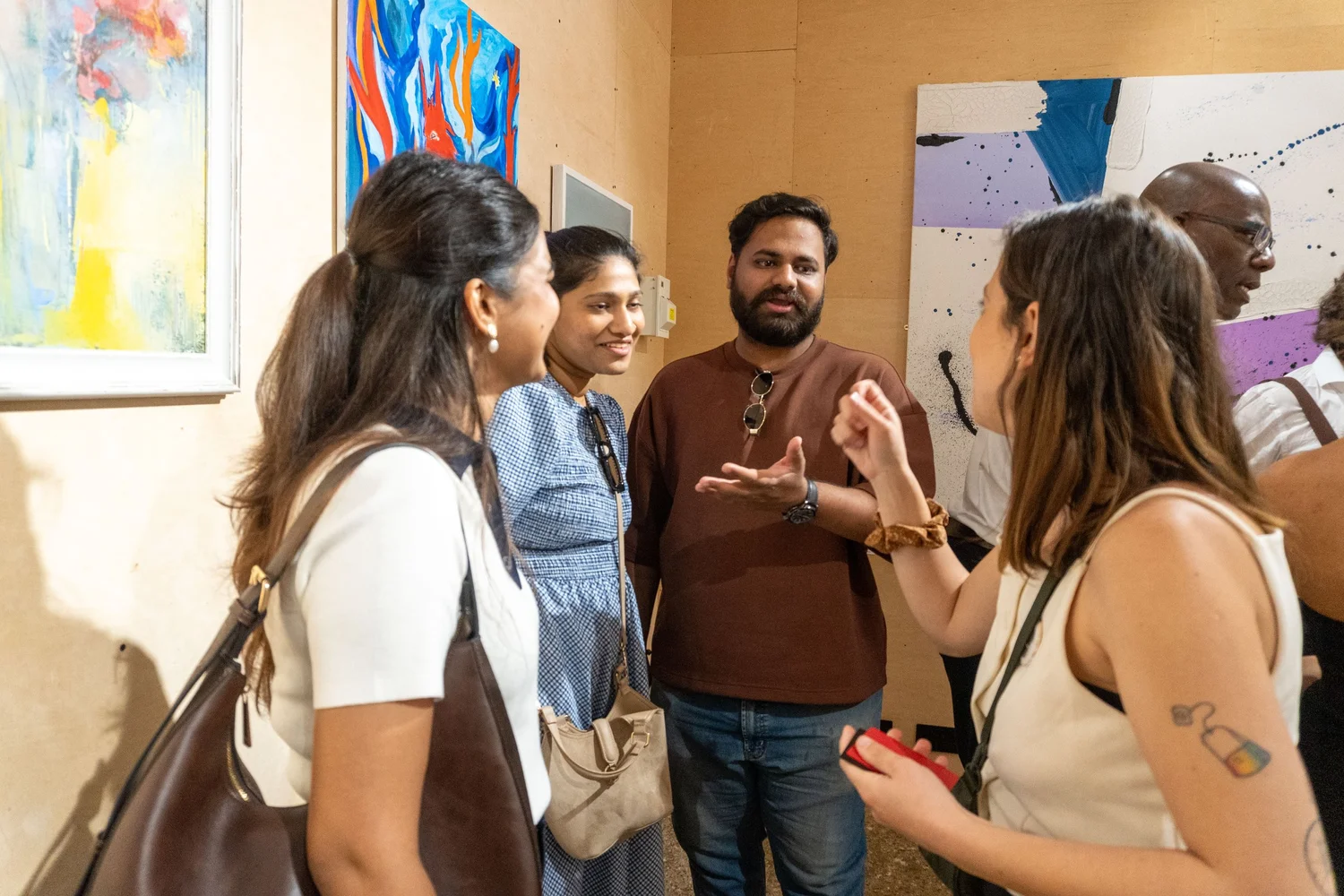
Artists and visitors at a HUGE Gallery exhibition in London, May 2026.
Start by reading the call properly
Every open call is slightly different, so begin with the details rather than the form. Before you prepare anything, check:
- The dates and venue. Can you, or your work, realistically be there?
- The deadline. Note it, then set your own deadline a day or two earlier.
- The formats. Is the show physical, digital or both? Are there size limits?
- The costs. Check exactly what the participation fee includes and what you would pay separately, such as shipping.
- Who it is for. Some calls want a particular career stage, location or theme.
For HUGE's London show, the venue, dates, deadline and current fees for each format are listed on our open calls page. You do not need previous exhibitions, and you can apply from outside the UK: you do not need to live locally or attend in person.
Choose fewer, stronger works
An application is not a retrospective. A small, coherent selection tells a clearer story than a wide sample of everything you have made. Ask yourself which works best represent what you are doing now, and which would sit well together on a wall or screen.
We cover this step in detail in how to choose artwork for an open call.
Make your images do the work
For most open calls, your photographs are the first viewing. A selector cannot see your brushwork or your paper stock unless the image shows it.
- Light evenly. Soft daylight from a window, without direct sun, is often enough. Avoid flash on glossy or glazed surfaces.
- Shoot square on. For flat work, keep the camera parallel to the surface so the edges stay straight.
- Crop to the work. Remove the floor, the easel and the sofa. If the edge of the work matters, leave a slim, neutral border.
- Check the colour. Compare the image on screen with the work in the room and correct obvious colour casts.
- Add a detail shot only if it helps. Texture, stitching or layered surfaces can justify a close-up.
- Use sensible file names. "surname-title-2026.jpg" is easier to keep track of than "IMG_4821.jpg".
Get the artwork details right
Inconsistent or missing information slows everything down. For each work, prepare:
- title
- year
- medium and support (for example, "oil on canvas" or "archival pigment print")
- dimensions, in the same order and unit every time (height × width × depth, in cm)
- whether it is framed or ready to hang
- price, if the work is for sale
Write these once in a document, check them, then copy them into the form. It saves time and avoids typing errors under deadline pressure.
Write a bio that a stranger can use
Your bio is not a CV. In three to five sentences, it should tell a reader who you are, what you make, where you are based and what drives the work. Specific is better than grand: "I paint small-scale interiors from memory, using egg tempera on board" says more than "I explore the boundaries of perception".
If you have shown work before, mention one or two relevant exhibitions. If you have not, simply describe your practice. That is perfectly acceptable for a show that welcomes emerging artists.
Check every link
Many application forms ask for a website or Instagram account. Before you submit:
- open the link on your phone as well as your computer
- make sure the account is public if you want it to be seen
- check that the work you submit is visible there, or is clearly in keeping with it
A link that does not open, or opens on something unrelated, is a missed chance.
Choose physical or digital deliberately
At HUGE you can apply for a physical or a digital place. A physical place puts the object in the room, which matters for texture, scale and materials. A digital place presents your work digitally as part of the exhibition, which can suit photography, digital work and moving image, or artists who cannot easily send work to London.
Choose the format that serves the work, then check what it costs and what you need to prepare for it on the open calls page.
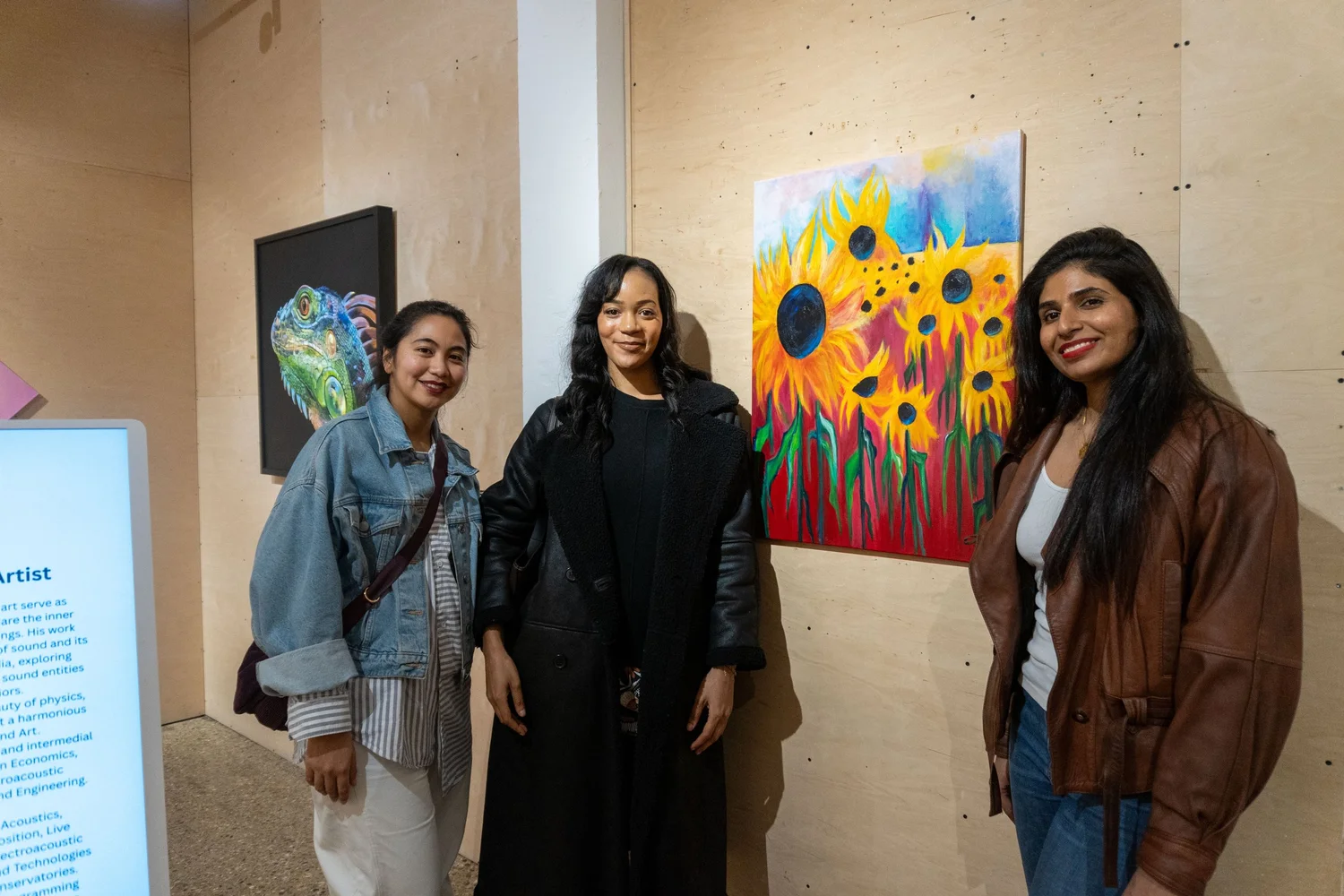
Artists and visitors at a HUGE Gallery exhibition in London, February 2026.
Submit this week, then plan ahead
With the deadline on 16 November, aim to submit a few days early. It gives you room to fix a broken file or answer a question. Once you have applied, read our first-time artist's checklist for exhibiting in London, which covers delivery, labels, presentation and follow-up if your work is selected, and our guide to talking about your work on opening night.
About HUGE's November show in London
HUGE Gallery's London exhibition runs from Friday 27 to Sunday 29 November 2026 at The Factory, 21–31 Shacklewell Lane, London E8 2DA. It opens with an evening private view on Friday 27 November, and the exhibition is open on Saturday 28 and Sunday 29 November from 11:00 to 17:00. Visitors can reserve a free place on Eventbrite, where the opening-night times are listed.
If you are visiting, our art-lover's guide to Hackney, Dalston and E8 suggests what else to see nearby. You can also see photographs from past HUGE shows, including our September 2026 London exhibition.
Showing in France as well? HUGE's Lyon exhibition takes place in Villeurbanne from 4 to 6 December 2026, with applications closing on 18 November. The details are on our open calls page.
Interested in exhibiting your work? Explore the current HUGE Gallery open call. Applications for London close on 16 November 2026.
