
From 4 to 6 December 2026, HUGE Gallery brings a selection of artists from around the world to 53 Cours Tolstoï, 69100 Villeurbanne, in the Lyon metropolitan area, for a three-day exhibition of physical and digital work. The show opens on Friday 4 December from 18:00 to 21:00. Before the doors open, we asked six of our exhibiting artists the same seven questions: how they started, what they're showing, how they work and what visitors in Lyon should look out for.
The answers come from painters and digital artists working in France, Austria, Portugal, India and Los Angeles: pointillist acrylic landscapes, portraits that merge acrylic with digital collage, a sacred digital mandala, veiled faces in acrylic and charcoal, a cactus in flower in acrylic over pastel, and luminous digital painting. We also put a personal question to each artist. Read on, then come and see the work in person.
Get your tickets on Eventbrite
Meet the Artists at a Glance
Six artists, six practices. Here is each artist with the work they submitted to HUGE Lyon. Their full profiles follow the interview.
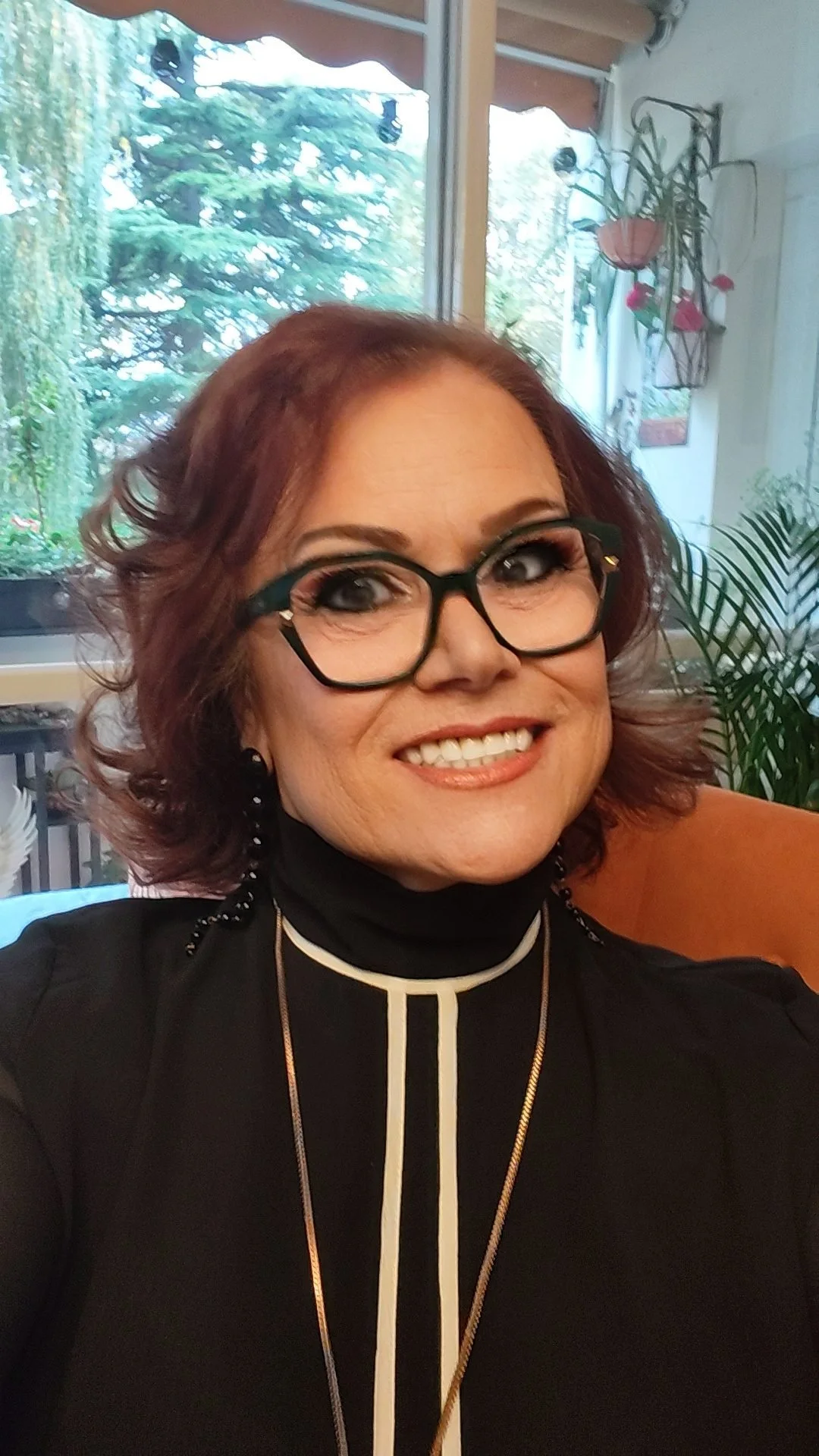
Catherine Vella
@colorfulcathie
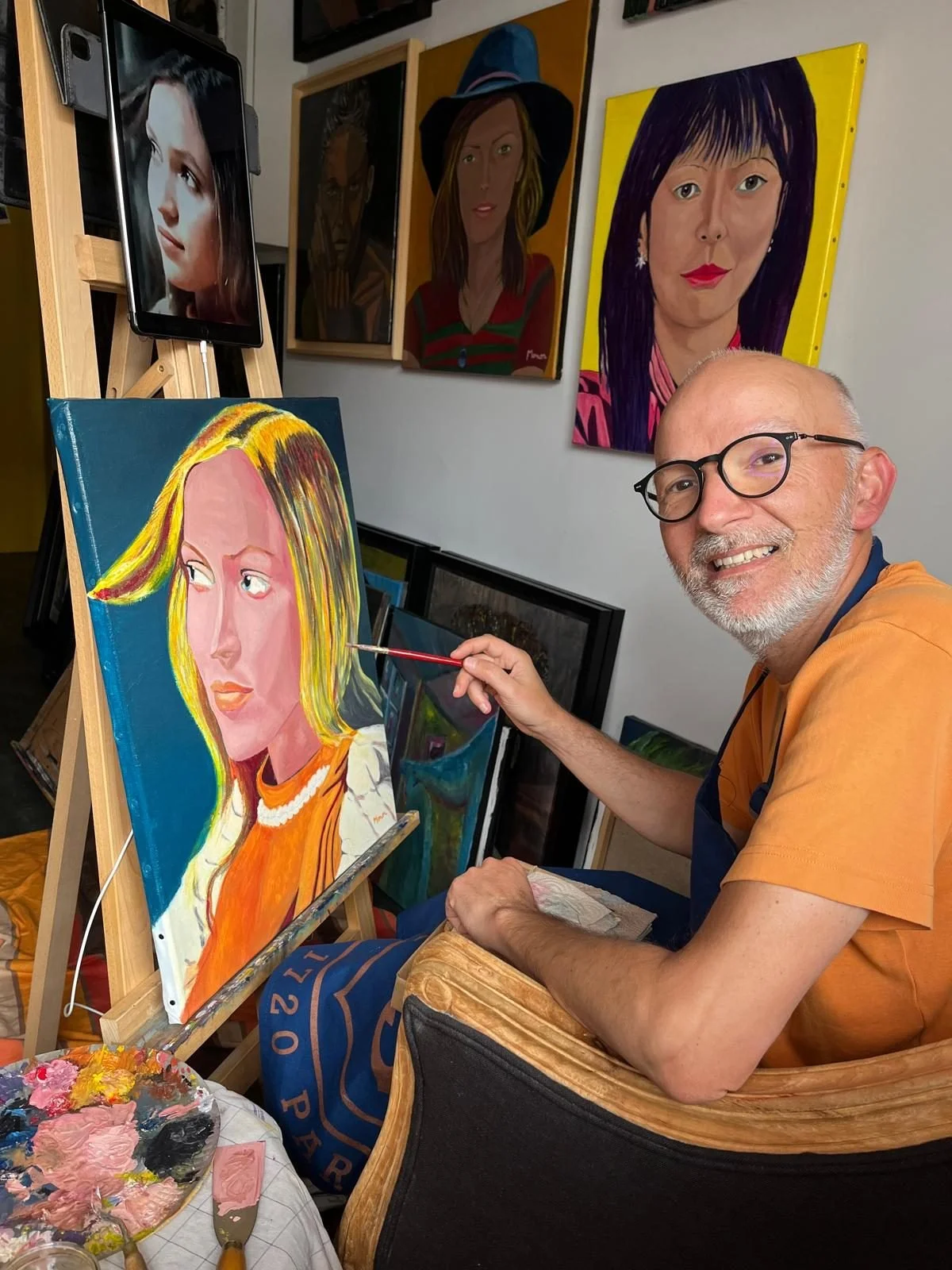
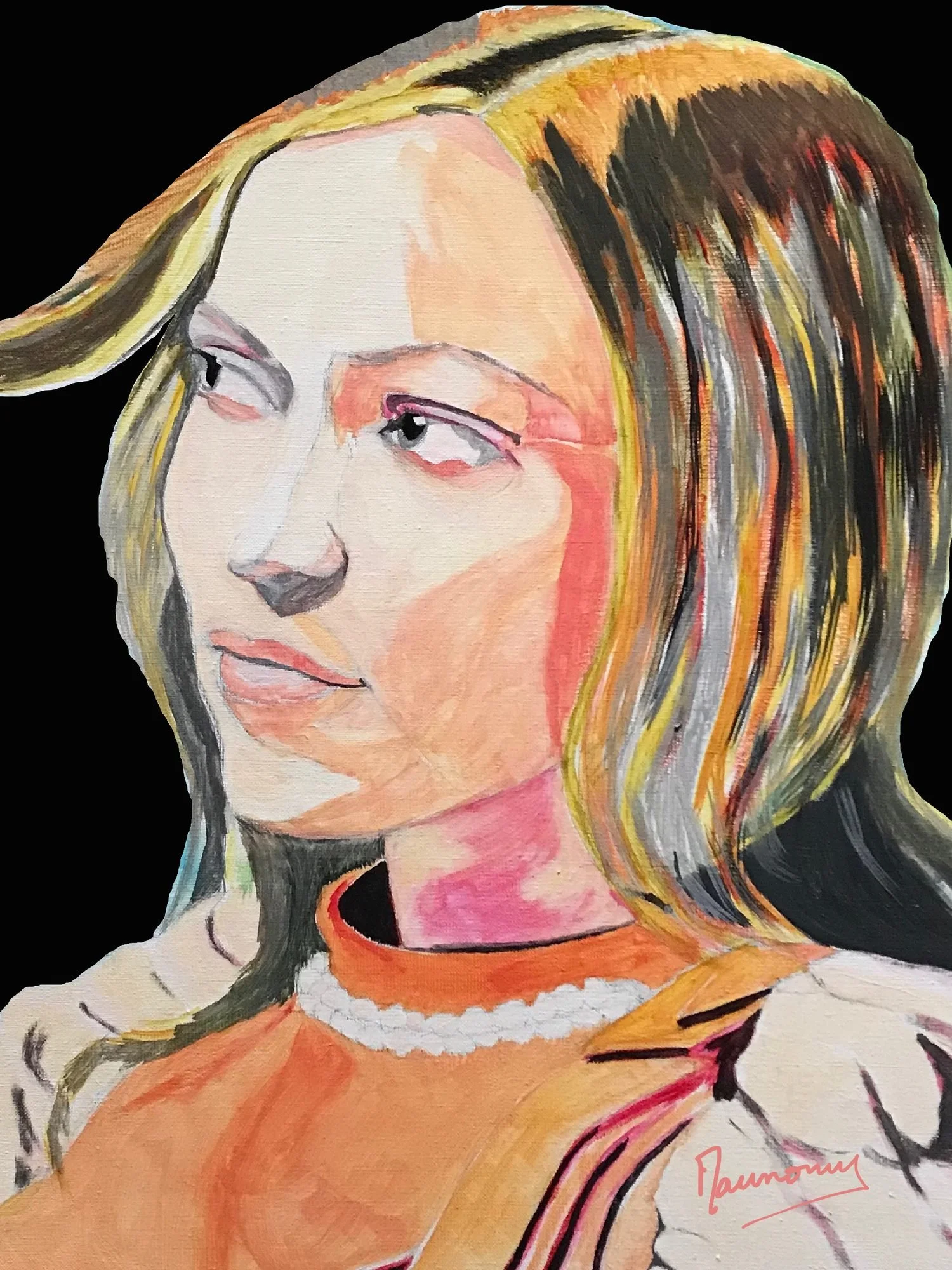
Franck Maunoury (Monor)
@monor_arts_franckmaunoury
Divya Vinod Gilatar
@thequeendomstudio
Manuela Dantand
@art.no.deco
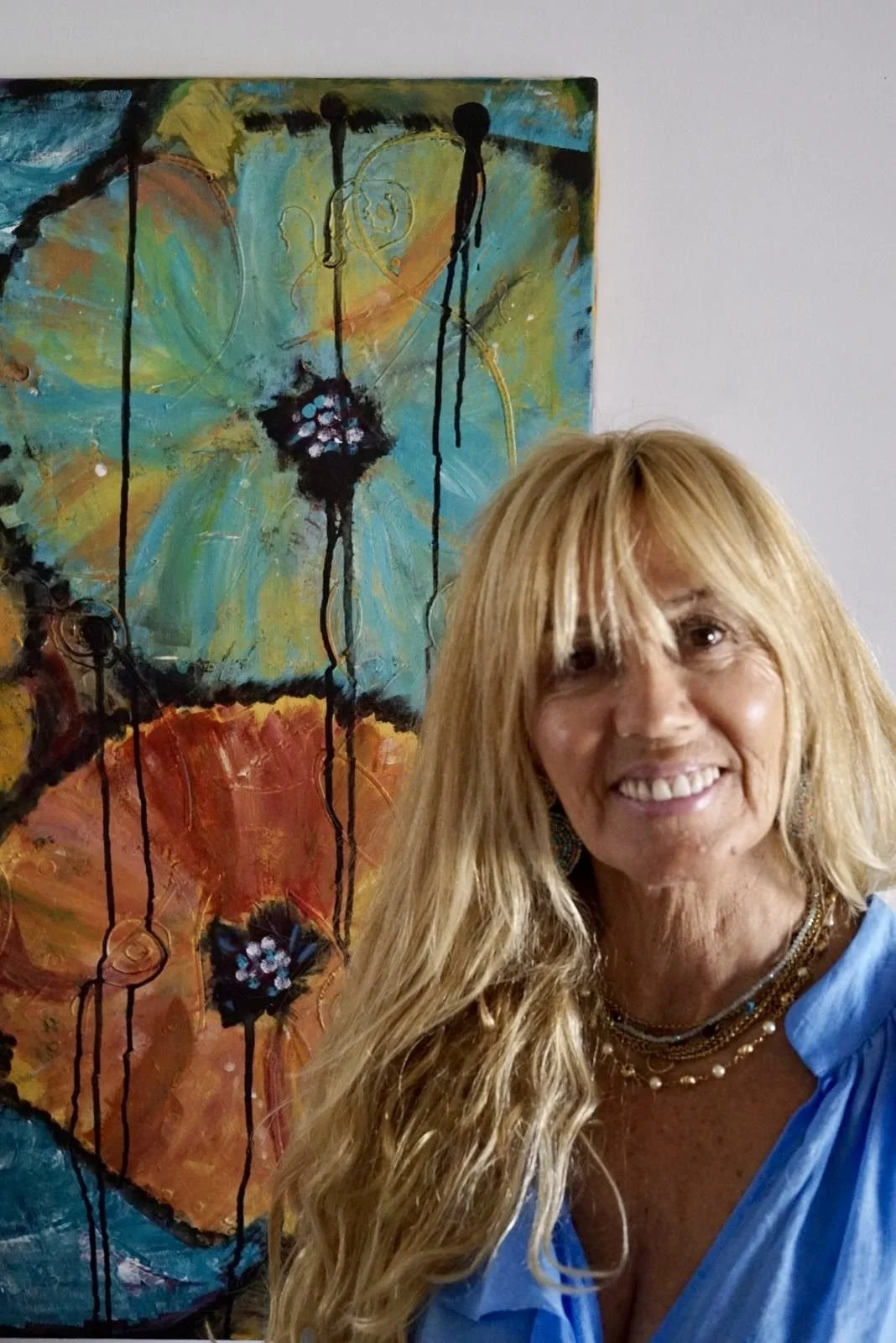
Rosa Almeida
@art_rosa.almeida24
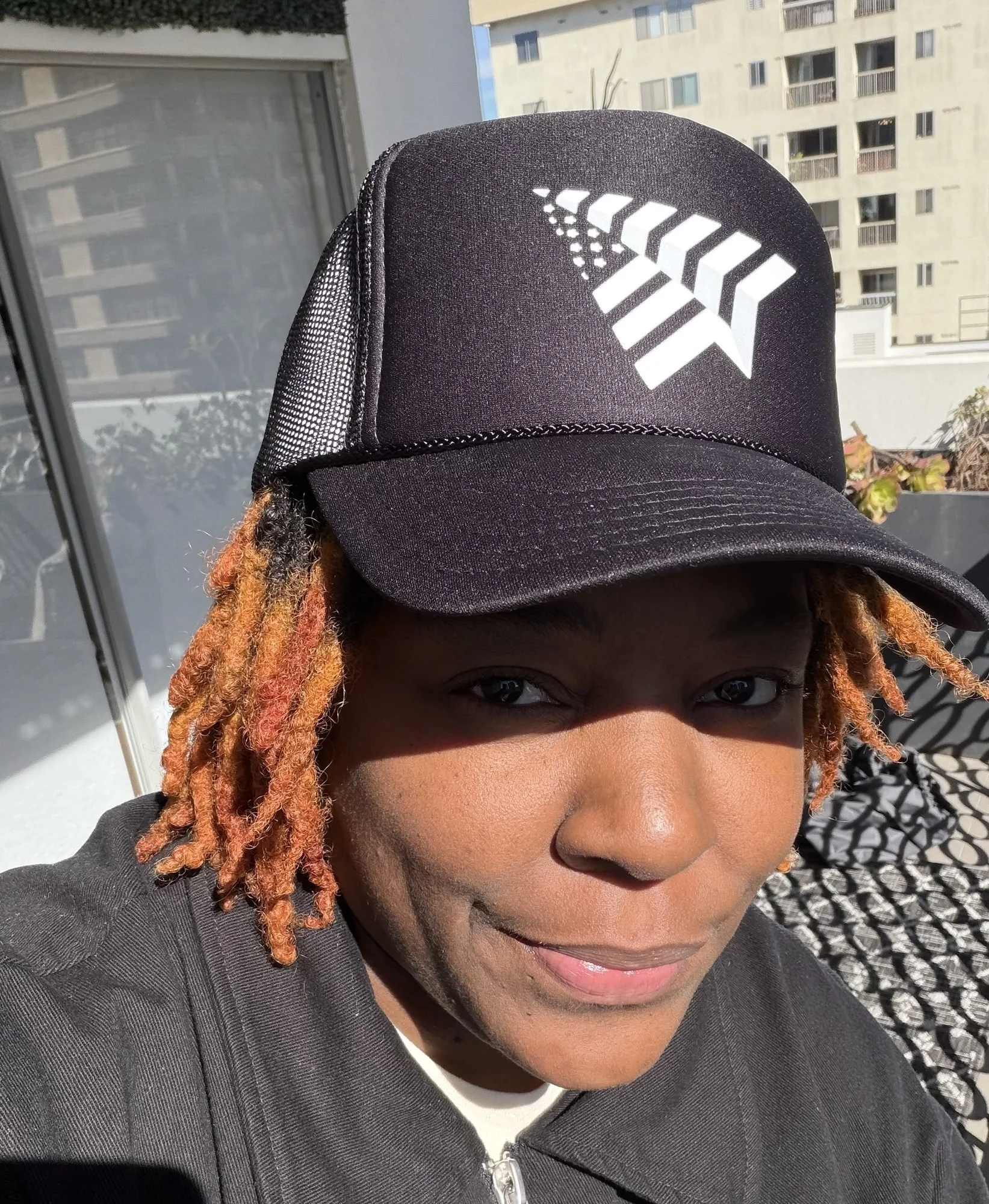
Alexis Lovely
@alexislovely
1. How did you first start making art, and what keeps you coming back to it?
Catherine Vella – @colorfulcathie
In November 1992, I was in a deep depression after a series of tragedies, including the death of my daughter. Almost by instinct, I bought a canvas, oil paints and brushes. I had never painted in my life. I painted all night, without stopping. I have never left painting since.
What brings me back to it is the desire to express that, beyond the terrible things, real life is very beautiful, and I would like my paintings to make the people who look at them feel that.
Franck Maunoury (Monor) – @monor_arts_franckmaunoury
I have been drawing and painting since childhood. Art has always been a way for me to observe the world more closely and to translate experience into something visible.
What keeps bringing me back is the possibility of exploring questions that cannot always be expressed through words: our relationship with other living beings, perception, memory and the fragile boundaries between the individual and the environment.
Divya Vinod Gilatar – @thequeendomstudio
Art has been part of my life for as long as I can remember. I started making art when I was five, but over time it became much more than creating something visually beautiful. It became a language through which I could explore spirituality, philosophy, femininity, memory and personal experience.
My background in philosophy, ancient history, writing and education also influences the way I approach image-making, because I am always interested in the stories, symbols and meanings beneath the surface. What keeps bringing me back is that art allows me to express ideas and emotions that sometimes cannot be contained by words alone.
Manuela Dantand – @art.no.deco
My journey into painting began in April 2020, during the COVID lockdowns. I was looking for something to keep myself busy, so I started painting our old garden furniture. Once I had painted everything, I thought, why not try painting on canvas?
That's how it all started. There was no big plan, and I certainly hadn't intended to become an artist. I simply started experimenting, trying new things, and somewhere along the way, I discovered my passion for painting.
What still fascinates me today is the freedom it gives me. I can start with an idea, explore colours and materials, and let the creative process surprise me. Sometimes a painting takes a completely unexpected direction. That's exactly what makes painting so exciting for me.
Rosa Almeida – @art_rosa.almeida24
Painting has always been a way for me to express what I sometimes cannot put into words. After a period in my life when other responsibilities took priority, I rediscovered the pleasure of painting and the freedom it gives me.
What keeps me coming back is the feeling of being completely absorbed in the creative process. Every blank surface is a new beginning, an opportunity to experiment, take risks and discover something unexpected. Painting brings me joy, curiosity and a sense of freedom that I find essential.
Alexis Lovely – @alexislovely
I first started making art when I was supposed to be taking notes in class, doodling in the margins. I always coloured outside the lines. I got good grades on art projects and chose art electives and design classes in high school. I'm still finding inspiration everywhere, and I keep coming back to art because creating feels like my purpose.
2. Tell us about the work you're showing in Lyon. What is it about?
Catherine Vella – @colorfulcathie
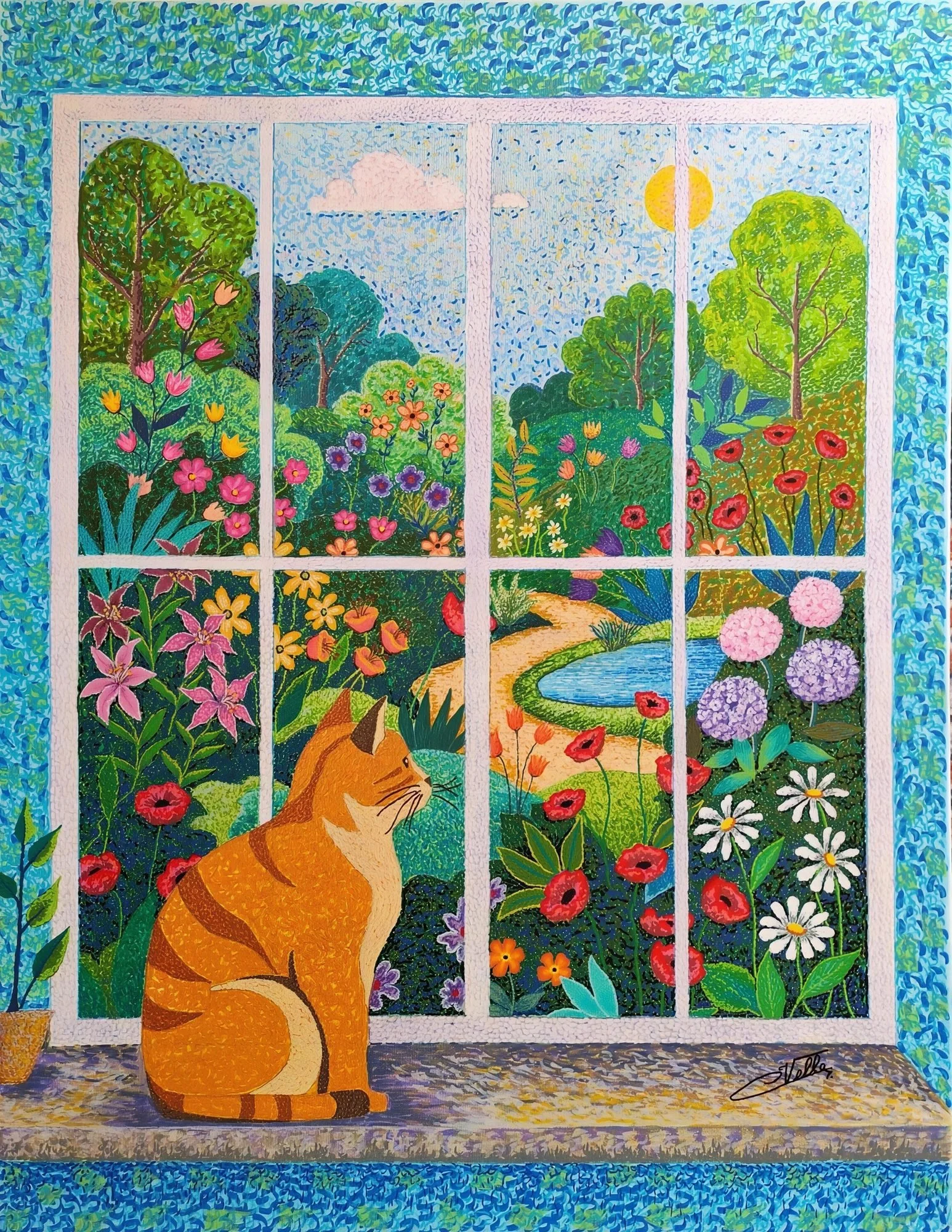
I am showing two canvases. Le chat à la fenêtre uses the very colourful palette and the pointillism that are my signature: a cat, an animal I love dearly, peacefully watches a garden full of flowers, in dazzling abundance, on a sunny day. The garden invites escape and serenity.
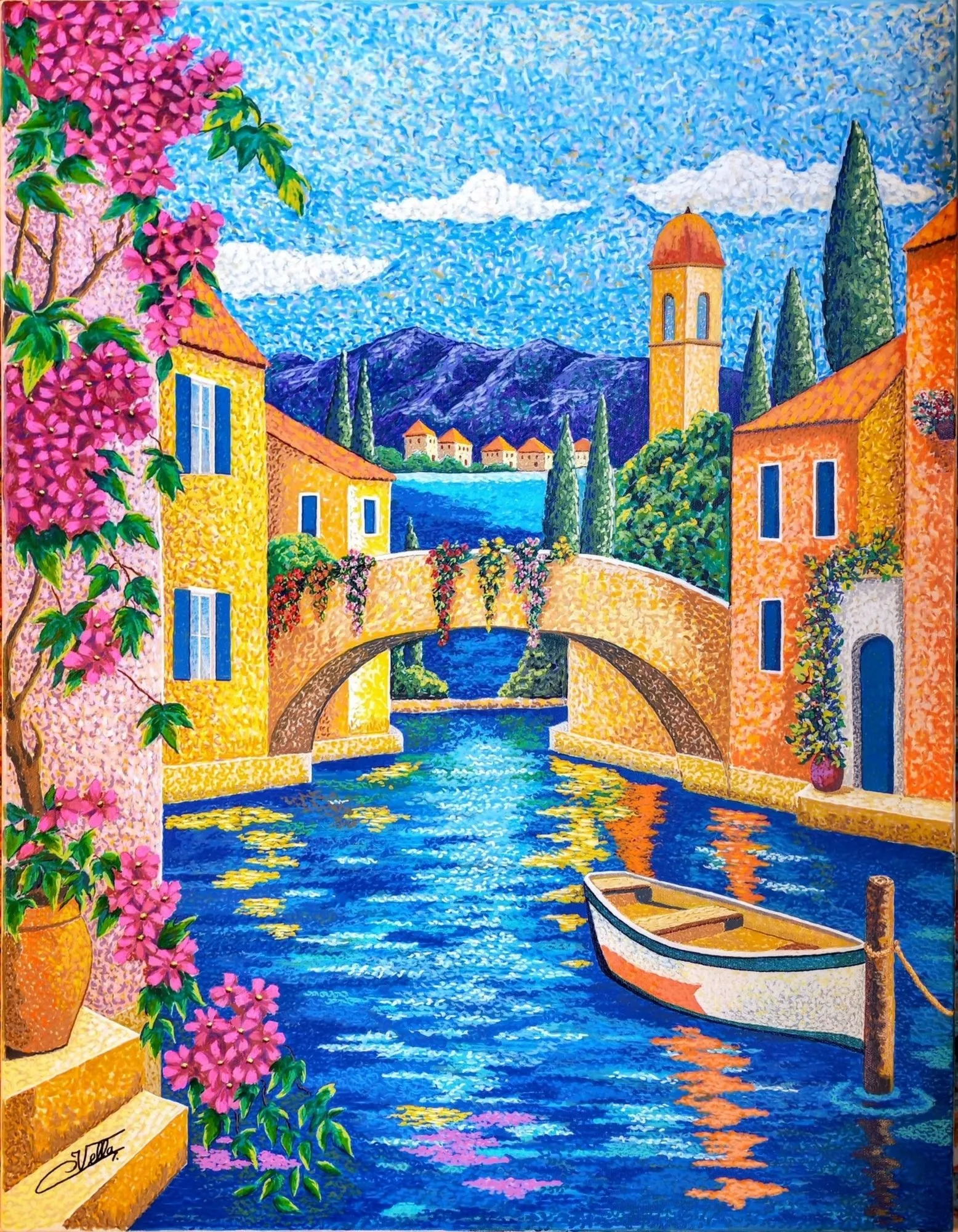
Souvenirs d'Italie is an imaginary landscape, a personal composition born of memories that mix a little of Venice with Mediterranean views: a canal, a flower-covered bridge, golden façades, a boat, cypress trees and mountains in the distance. The sun, bright colours and flowers are dear to me. This landscape invites travel and contemplation.
Franck Maunoury (Monor) – @monor_arts_franckmaunoury
The Holobiont series explores the idea that an individual living being is never truly isolated. We exist in constant interaction with microorganisms, other species and our environment. The works question the traditional idea of the autonomous individual and suggest instead a more interconnected vision of life. The three pieces presented in Lyon combine the human figure with organic and fragmented visual elements to evoke this coexistence.
Divya Vinod Gilatar – @thequeendomstudio
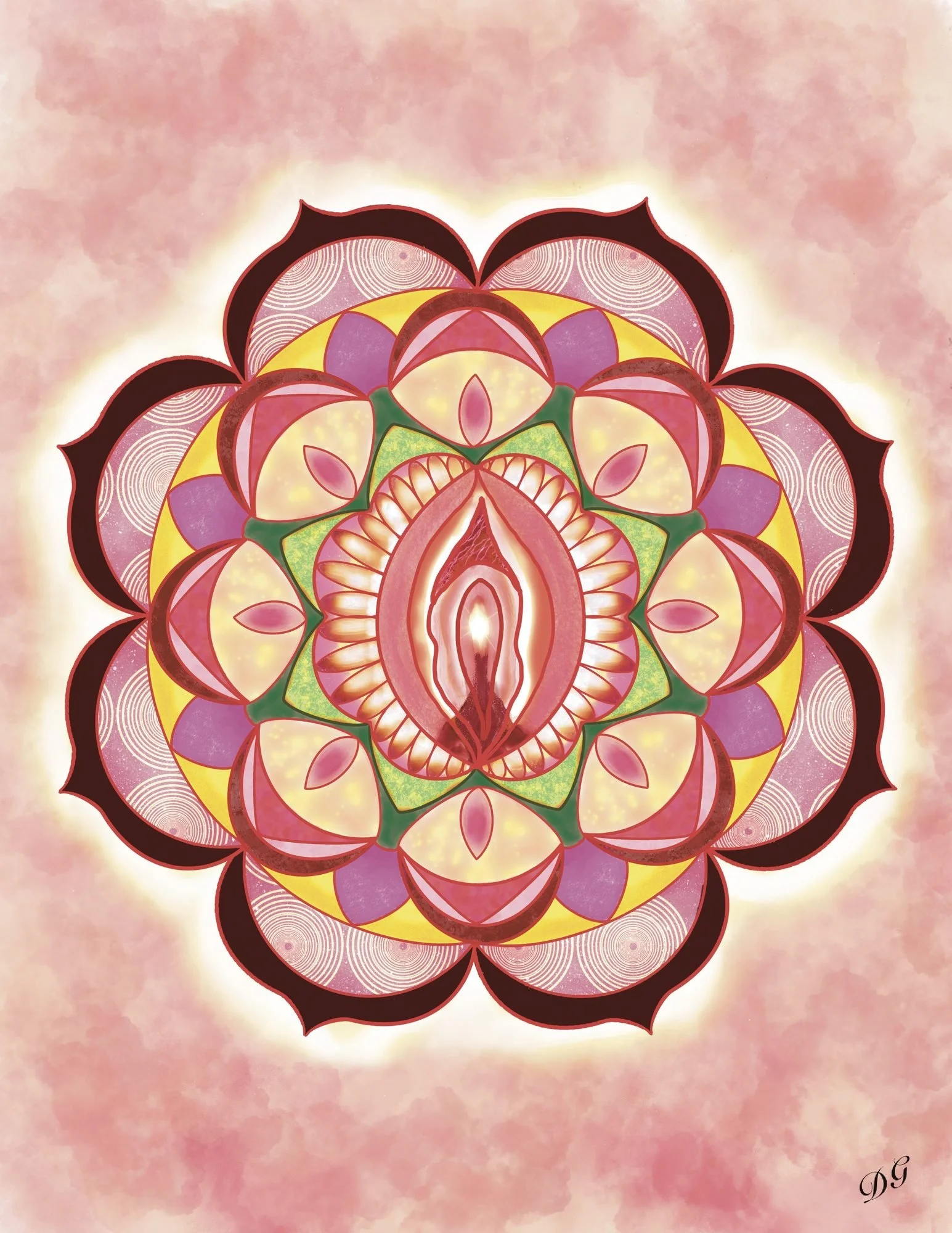
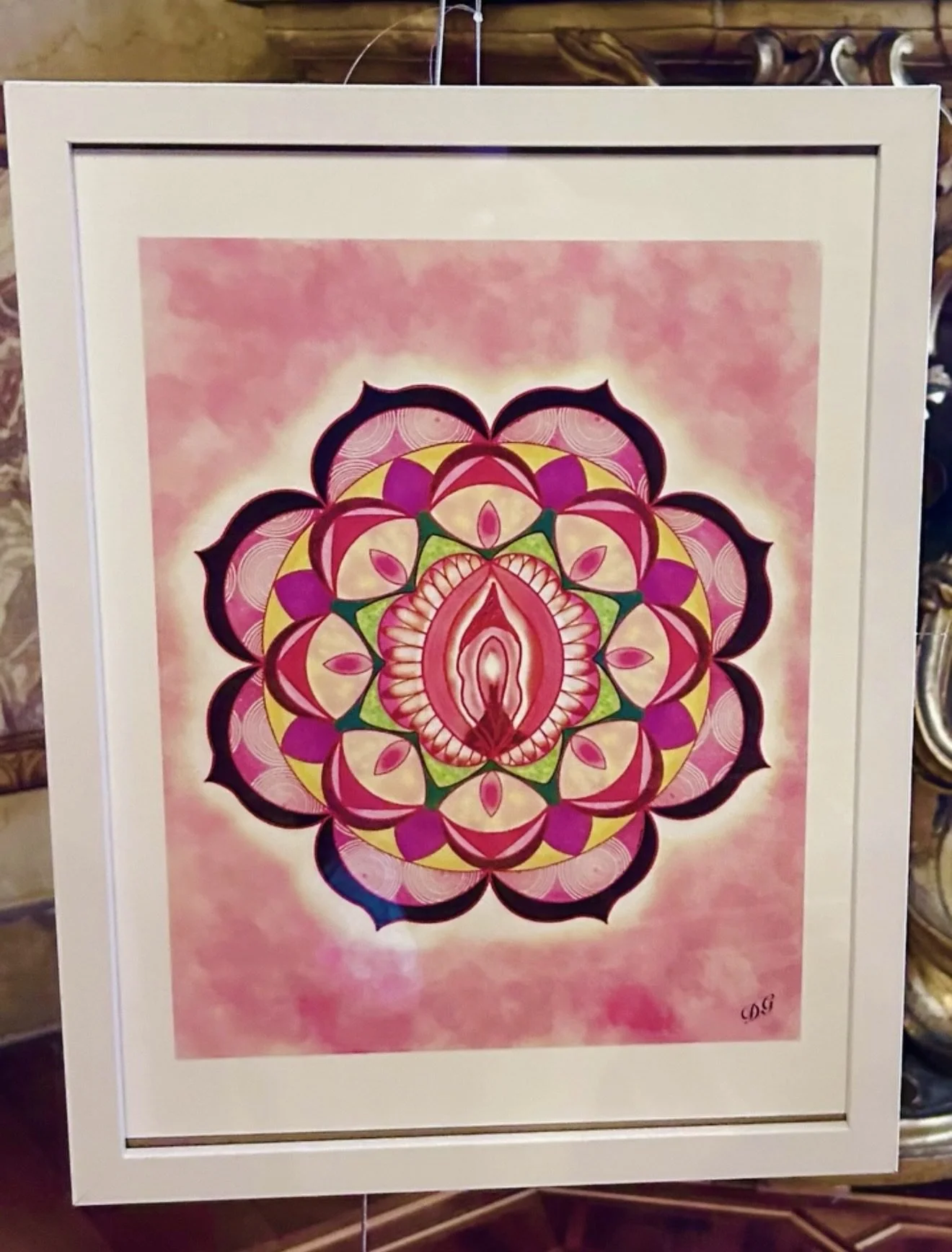
Holy Blood is part of my Shakti in Motion series, which explores feminine embodiment, spirituality and the many ways womanhood can be understood as sacred rather than something to be hidden or diminished. The work draws upon the symbolism of menstruation, the womb and the divine feminine, particularly through Indian spiritual traditions and the energy associated with Maa Kamakhya.
I wanted to transform something often surrounded by shame or discomfort into an image of power, creation and reverence. For me, the work asks what changes when we begin to view the female body through a sacred rather than restrictive lens.
Manuela Dantand – @art.no.deco
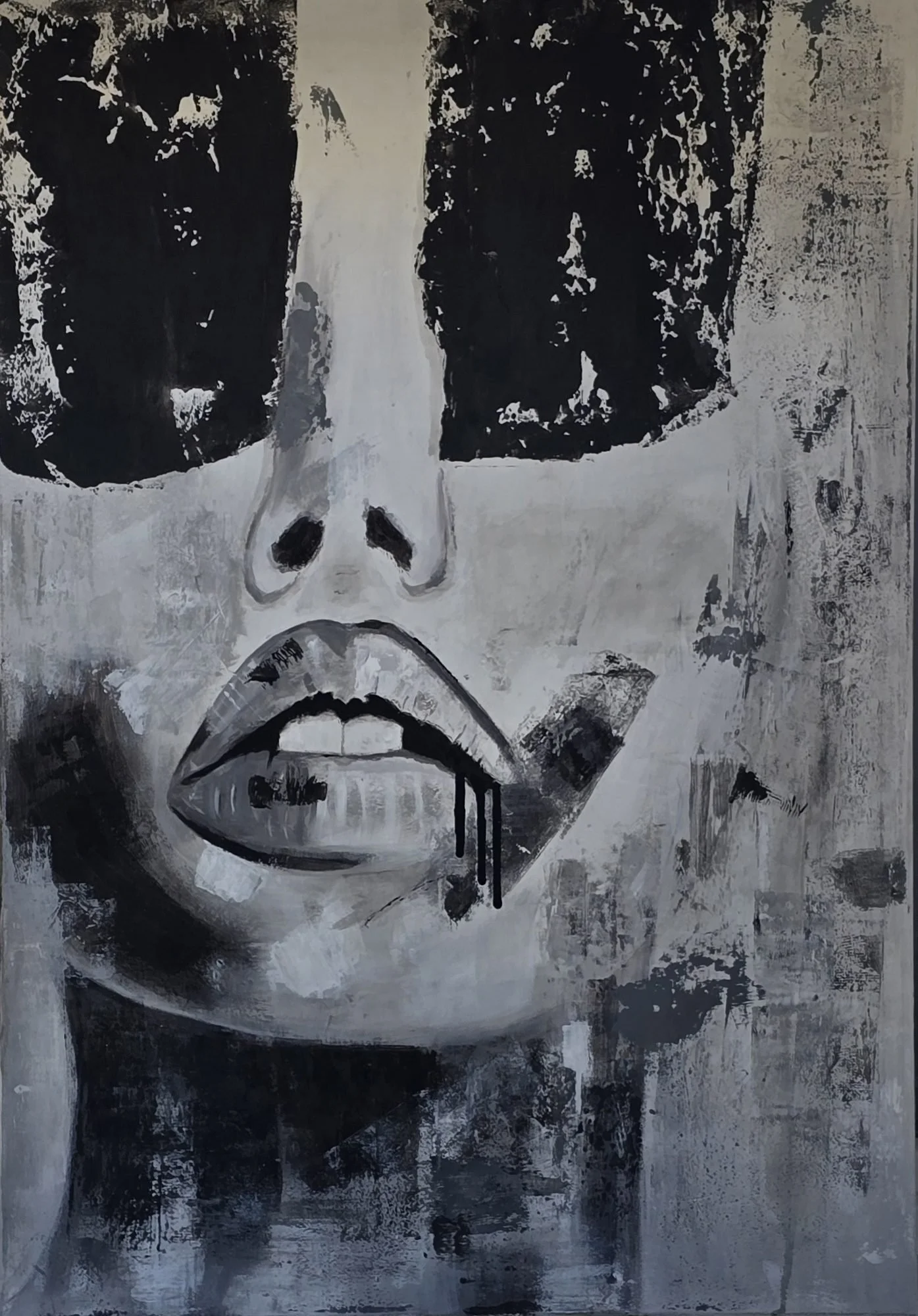
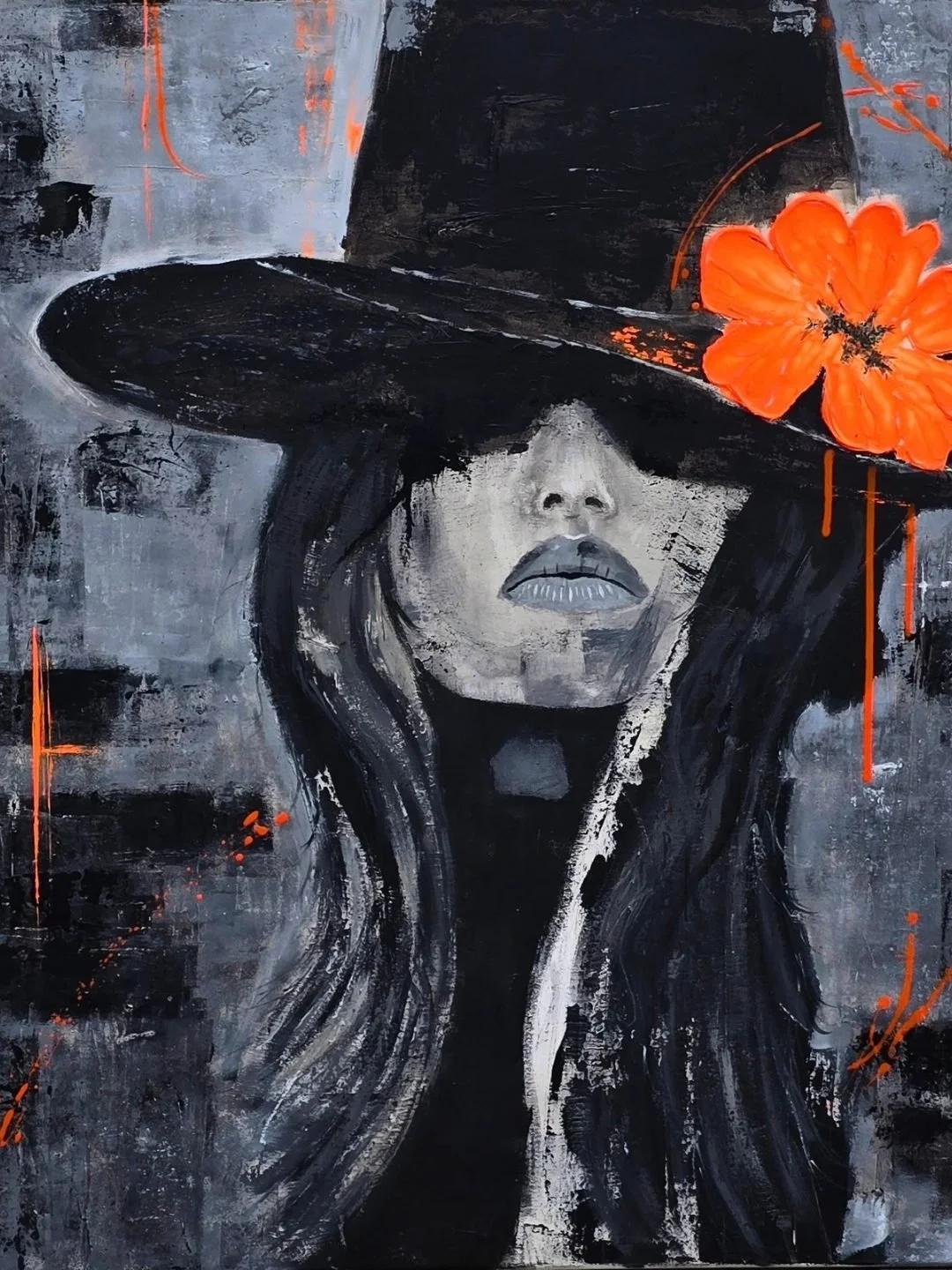
With VEILED, I was fascinated from the very beginning by the aesthetics of a partially concealed face. I wanted to create a portrait that doesn't reveal everything, and that becomes even more intriguing because of it. The idea was clear from the start. I was interested in the interplay between the visible parts of the face, the dark areas and the different textures.
I love the tension between soft transitions and strong contrasts. For me, this creates a portrait that feels both quiet and expressive. Not every artwork I create needs to tell a deeper story. Sometimes everything begins with a visual idea that simply won't leave my mind. That's exactly how VEILED came to life. What people see or feel when looking at it is entirely up to them.
Rosa Almeida – @art_rosa.almeida24
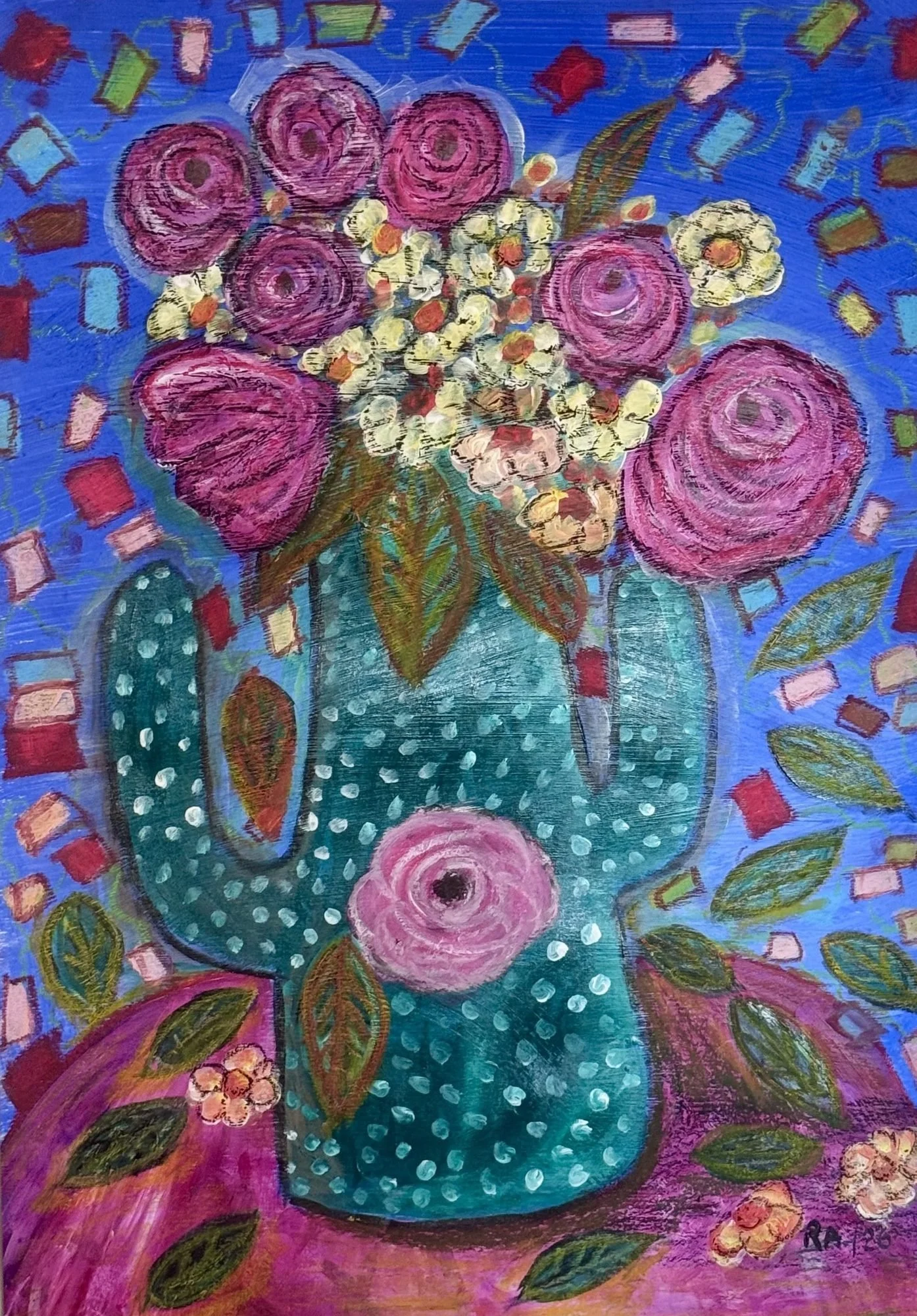
Cactus in Bloom is a celebration of nature, colour and imagination. I was inspired by the fascinating character of the cactus and the unexpected beauty of flowers. I wanted to create a playful and expressive composition in which organic shapes, vibrant colours and different textures come together.
The cactus almost becomes a living vessel, overflowing with flowers and life. For me, the painting is about the joy of creation, the abundance of nature and the beauty of allowing imagination to take its own direction.
Alexis Lovely – @alexislovely
The work I'm showing in Lyon is about self-actualisation, which I think of as growing into who you're capable of becoming. In life, that means getting to know yourself and trusting what feels true to you. As an artist, it means experimenting until you recognise the choices that feel distinctly yours. That's how a signature style begins to take shape.
3. What materials and processes do you use, and why do they suit what you want to say?
Catherine Vella – @colorfulcathie
I have been working in acrylic for a few years. I developed my technique by experimenting in my studio: I build up my canvases in small touches, with dots and strokes. I love this way of painting because it gives my work texture and a great deal of originality. It is meticulous work that demands an enormous amount of patience.
Franck Maunoury (Monor) – @monor_arts_franckmaunoury
The Holobiont works combine acrylic painting on canvas with digital collage. I begin with a physical painting, then extend and transform it digitally. This combination is important to me because the work itself becomes hybrid. The materiality of paint and the flexibility of digital imagery coexist in the same piece, reflecting the idea of multiple systems and identities existing within a single organism.
Divya Vinod Gilatar – @thequeendomstudio
I began by working traditionally with mixed media on paper before gradually moving into digital art. I now primarily create on an iPad, moving between Adobe Fresco and Procreate, with occasional editing in Adobe Illustrator when required. My process remains very intuitive and often meditative.
I build compositions slowly through layers of drawing, colour, texture and symbolic detail, allowing the work to evolve in response to its emotional or spiritual idea. Digital media gives me enormous freedom while retaining the intricacy and symmetry central to my visual language. I enjoy bringing ancient spiritual and symbolic references into a contemporary medium: ancient, but made modern.
Manuela Dantand – @art.no.deco
I mainly work with acrylic paint, charcoal and different textural materials. Depending on the artwork, I also use modelling paste, sand or spray paint. I love experimenting with materials and discovering how they interact. I often work in layers, painting over certain areas or deliberately leaving marks and traces visible. In VEILED, the contrasts between soft transitions, dark surfaces and expressive lines play an important role.
For me, the materials don't always have to be perfectly controllable. Sometimes the most interesting details appear unexpectedly while I'm experimenting. That is what makes every piece unique and keeps the creative process exciting for me.
Rosa Almeida – @art_rosa.almeida24
I mainly work with acrylic on canvas and paper, often combining acrylic with pastels and other drawing materials. I love the freedom these materials offer and the possibility of building layers, creating textures and exploring contrasts.
My process is largely intuitive. I use brushes, spatulas and sometimes direct gestures, allowing colours and shapes to interact. I don't always know what the final image will be. I enjoy the dialogue between control and spontaneity, and the unexpected results that emerge along the way.
Alexis Lovely – @alexislovely
I work mainly with digital tools because they give me room to experiment. I can change a colour, play with texture, or take an idea in a completely different direction and see how it changes the feeling of a piece. I'm drawn to what's next in technology and what new tools might let me do with my art.
4. What does a typical day in your studio look like?
Catherine Vella – @colorfulcathie
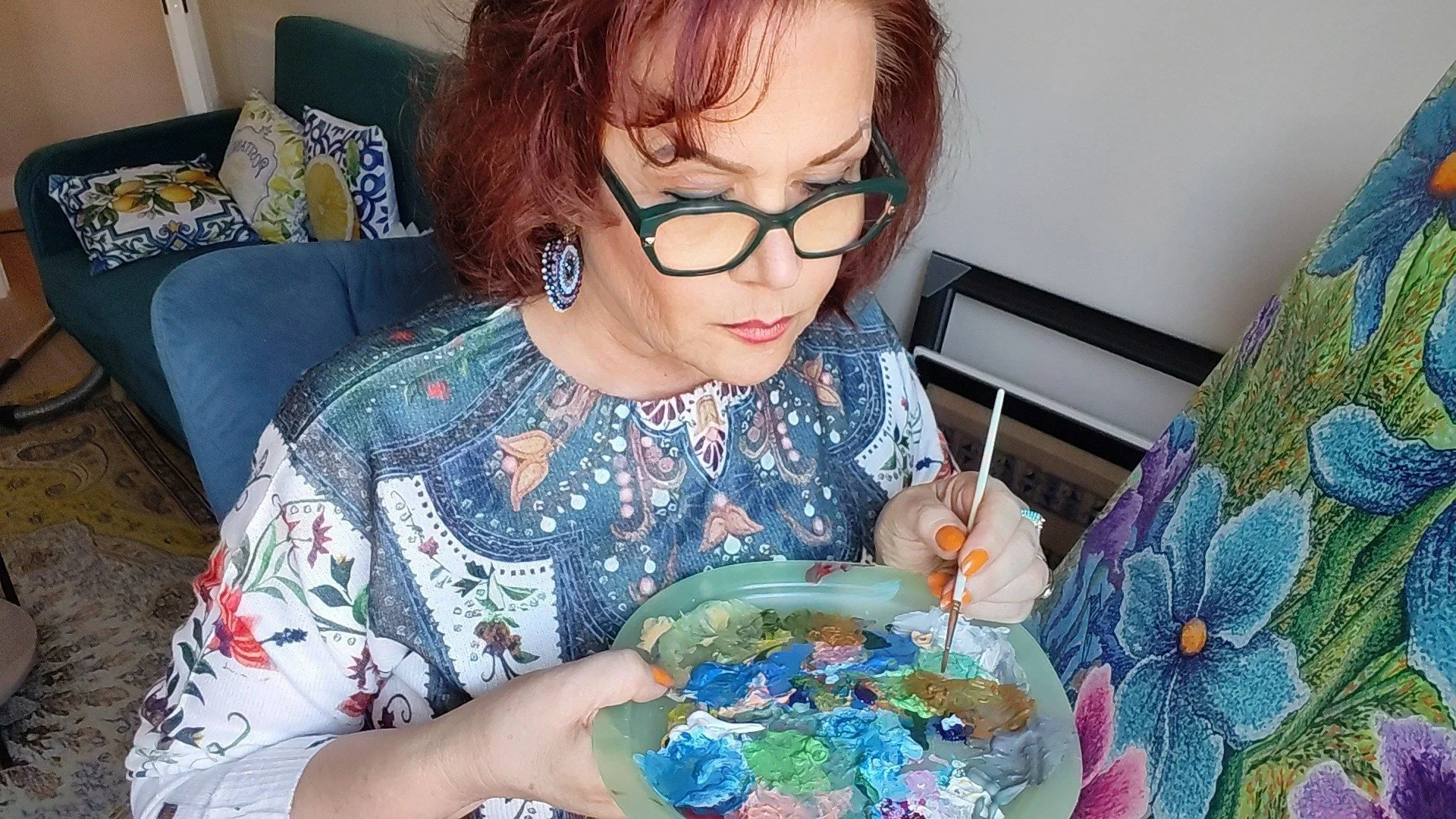
I am retired, so my days begin with a coffee, the housework and getting ready. Then, if nothing urgent needs doing, I devote myself to painting: I work on a painting in progress or look for the composition of a new subject. I am completely absorbed and I don't count the hours.
I love cooking, especially for my family and friends, but when I paint I make do with some fruit or a salad, with short coffee breaks. I often paint until 2 or 3 in the morning, sometimes later.
Franck Maunoury (Monor) – @monor_arts_franckmaunoury
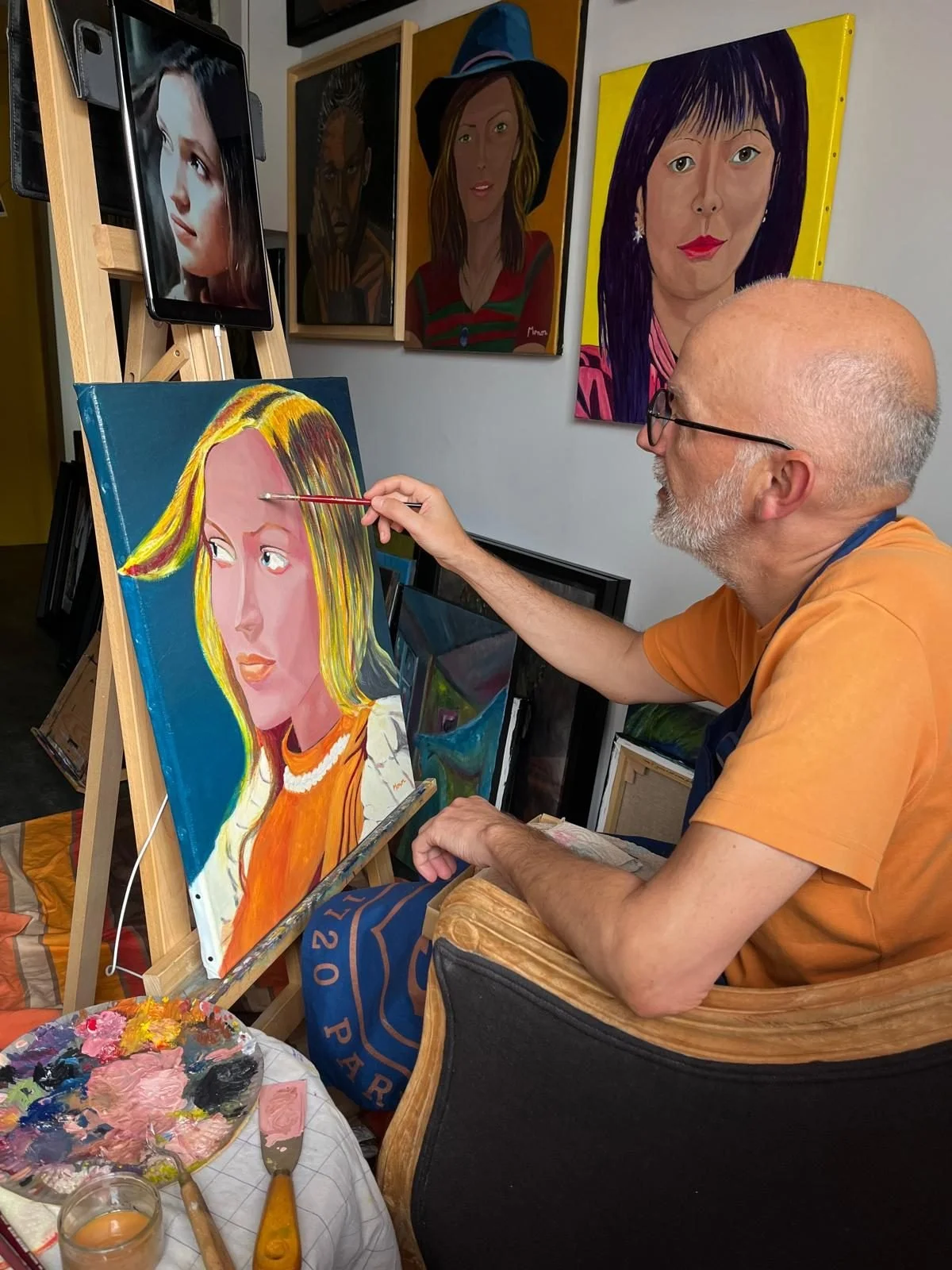
There is no completely typical day. Some days are devoted to painting, while others involve drawing, reading, researching scientific ideas or working digitally. Observation and research are an important part of the process. I often move back and forth between intuitive work and a more analytical approach, allowing the image to develop gradually rather than following a fixed plan from the beginning.
Divya Vinod Gilatar – @thequeendomstudio
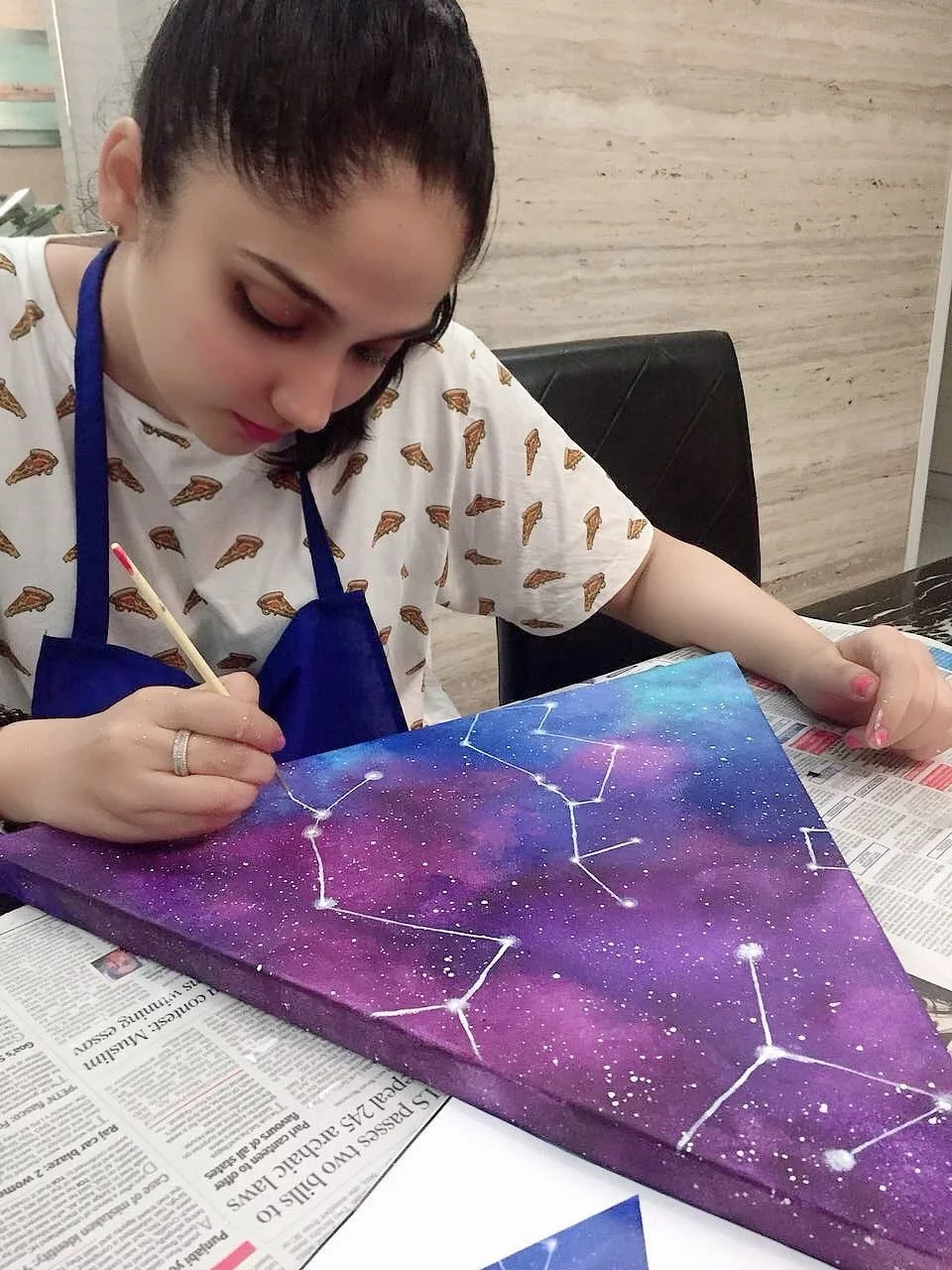
My studio practice is rarely confined to a conventional studio routine. Much of my work is created on my iPad, so my creative space can move with me. I might begin by writing, researching a spiritual or philosophical idea, meditating, reflecting on an experience, or simply sitting quietly with an image that has been forming in my mind. Sometimes the process feels almost like channelling an idea before giving it visual form.
Once I begin drawing, I can become completely absorbed for hours. I often move between visual art and writing, and I enjoy that fluidity. For me, creating is less about following a rigid schedule and more about recognising when an idea is asking to be expressed.
Manuela Dantand – @art.no.deco
There isn't really such a thing as a typical day in my studio. Sometimes I arrive with a very clear idea in mind. On other days, I simply start experimenting and see where it takes me. I enjoy working with different materials and colour combinations. Sometimes I rework the same area several times because something doesn't feel quite right yet.
I regularly step back from the canvas to look at it from a distance and decide whether something is missing or whether the painting is already finished. I love those moments when everything suddenly comes together. Sometimes all it takes is one small change.
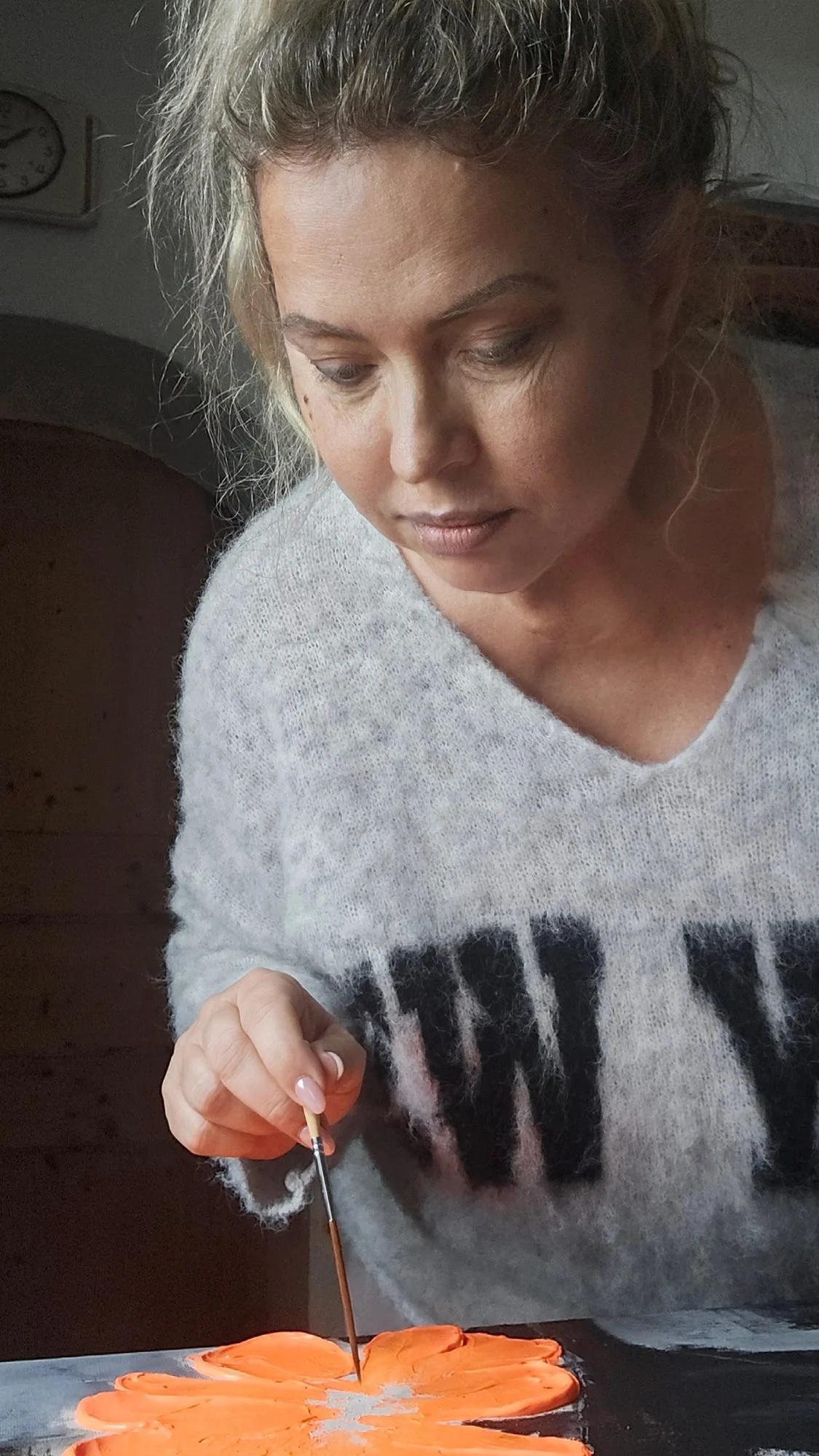
Rosa Almeida – @art_rosa.almeida24
There isn't really a typical day. Sometimes I begin with an idea, a colour combination or an image that has stayed in my mind. Other times, I simply stand in front of a blank surface and let the painting guide me.
I move between working with brushes and spatulas, adding layers, removing, changing and sometimes starting again. I often step back, observe and let a painting rest before deciding what it needs. For me, creating is as much about listening and observing as it is about painting.
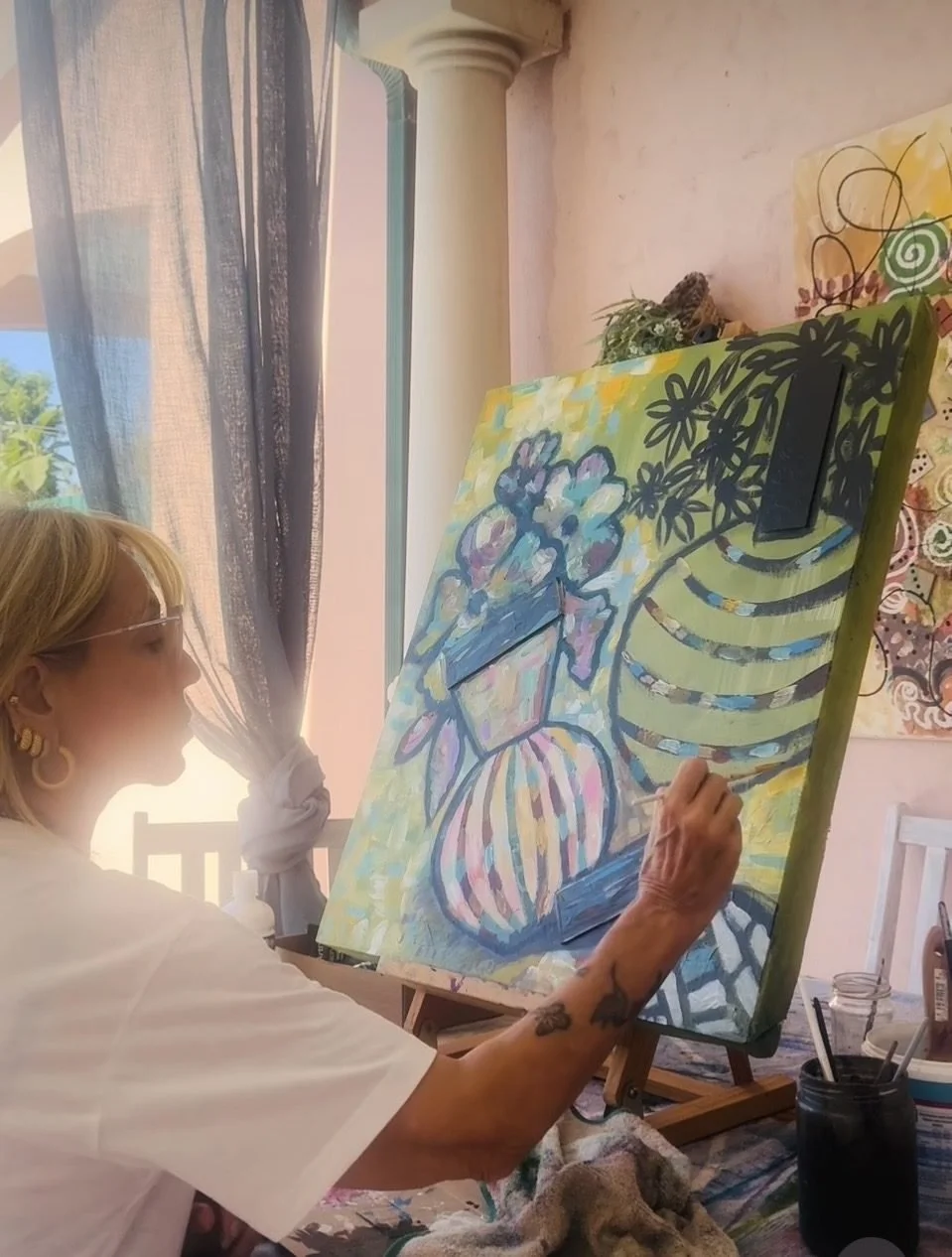
Alexis Lovely – @alexislovely
A typical studio day varies. As long as I have my laptop, my studio can be wherever I am. I especially love working by the water. It helps me slow down and get into a flow state, where I lose track of time and can follow an idea long enough to see where it takes me.
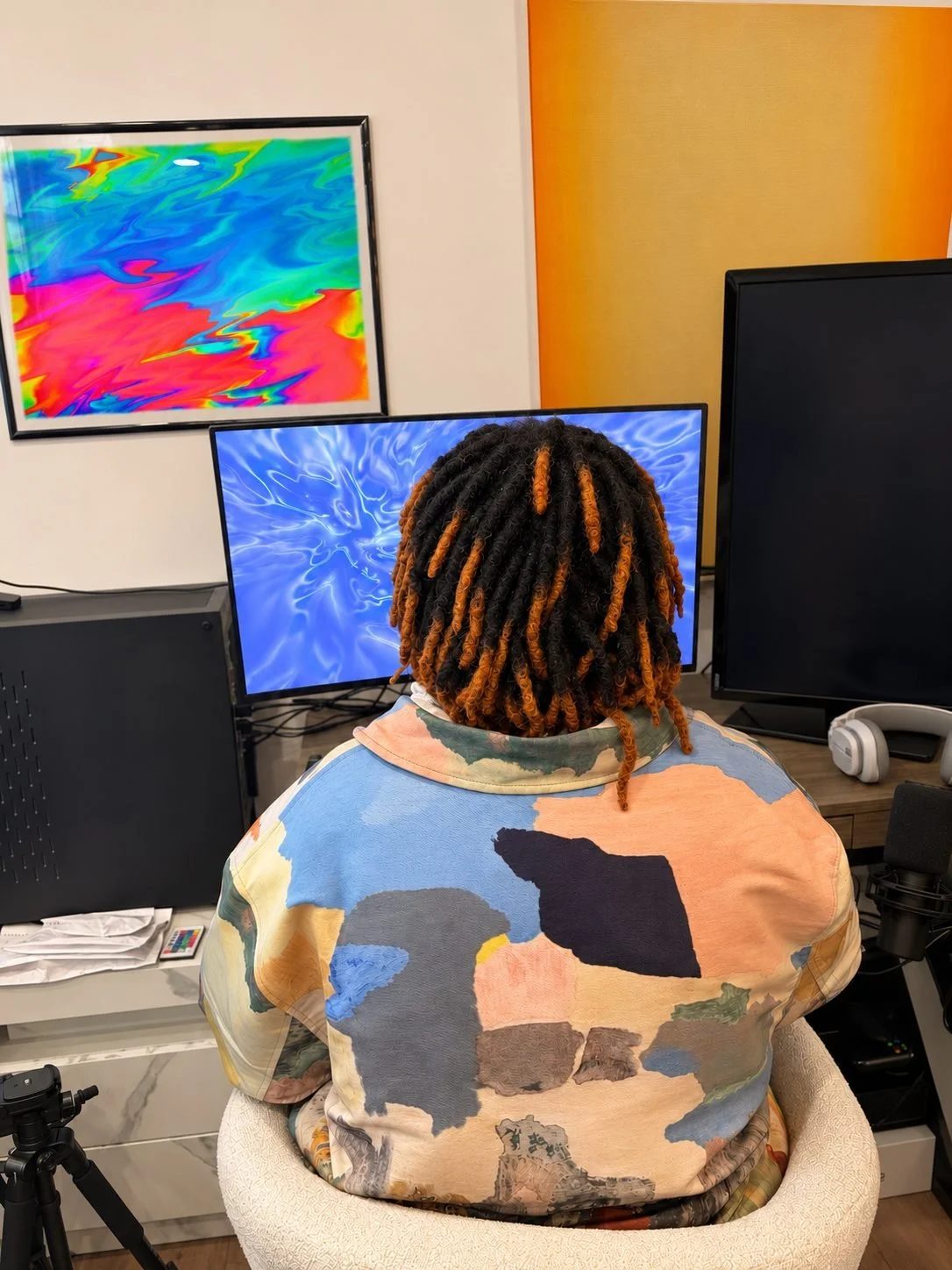
5. Who or what has influenced your practice most?
Catherine Vella – @colorfulcathie
I have never tried to take inspiration from another artist. I admire the work of some, and I have my own tastes like everyone else, but that doesn't influence what I do. My real source of ideas is nature, in everything it offers us.
I am a deeply spiritual person and I feel immense gratitude for what surrounds us. I don't try to reproduce exactly what I see: I want to put on canvas the emotions and the energy I feel when I observe nature, to which I have been very sensitive since childhood.
Franck Maunoury (Monor) – @monor_arts_franckmaunoury
My influences come both from art and from science. Academic drawing and painting remain important foundations in my practice, but I am equally interested in contemporary questions around biology, ecology and our understanding of living systems. The dialogue between scientific knowledge and subjective perception has become increasingly central to my work.
Divya Vinod Gilatar – @thequeendomstudio
Indian philosophy, spirituality and the divine feminine have profoundly influenced my practice, alongside my own experiences as a woman moving through different cultural and geographical spaces. I am especially drawn to Shakti, the concept of divine feminine energy, and to traditions in which the female body, creativity and life-giving power are understood as sacred.
My academic background in philosophy and writing also shapes the way I approach art, as I naturally think through symbolism, narrative and questions of identity, existence and meaning. Personal experience brings all of these influences together and gives my work its emotional and spiritual core.
Manuela Dantand – @art.no.deco
My biggest inspiration actually comes from my own spontaneous ideas. Sometimes an image suddenly appears in my mind, completely unexpectedly, and I want to find out if and how I can bring it to life on canvas. I don't consciously follow the work of one particular artist. Instead, I trust my curiosity and my instinct for colours, shapes and contrasts.
While I'm painting, an original idea can change completely. I might try something, reject it, or discover an entirely new direction by accident. That's what I enjoy so much about my work. I want to keep the freedom to experiment, explore new possibilities and surprise myself along the way.
Rosa Almeida – @art_rosa.almeida24
Nature, colours, movement and my own life experiences are probably my greatest sources of inspiration. I am particularly drawn to flowers, organic forms and the beauty of everyday details.
Travelling also has a strong influence on my work. Different landscapes, cultures, architecture and encounters often leave visual impressions that find their way into my paintings. I am interested in the emotions and memories that these experiences awaken rather than simply reproducing what I see.
Alexis Lovely – @alexislovely
Life itself inspires me most. My experiences shape what I make, and my spirituality shapes how I pay attention to them. Believing in something greater than myself reminds me to cherish each moment. Sometimes I only realise how much a moment stayed with me when I sit down to make something.
6. When visitors in Lyon stand in front of your work, what should they look out for?
Catherine Vella – @colorfulcathie
I would like visitors to let themselves be carried away into a marvellous world, where for a moment we forget the sad things we all live through. I would like the generous colours to transport them and take them somewhere new. I would like them to feel my message: not to forget to focus on the magnificent things our senses allow us to enjoy.
I can't convey the scents or the delightful rustling of nature, but I hope my paintings are strong enough to revive the people who contemplate them and lift their spirits.
Franck Maunoury (Monor) – @monor_arts_franckmaunoury
I would invite viewers to look beyond the first impression of the human figure and notice the relationships between the different layers, fragments and organic forms. The works are not intended to illustrate a scientific concept literally. Instead, I hope they create a sense that the boundaries of the individual are less stable than they appear, and that every living being is part of a much larger network.
Divya Vinod Gilatar – @thequeendomstudio
I would love viewers to first experience Holy Blood intuitively through its colour, symmetry and central forms before considering the symbolism beneath them. The imagery intentionally draws attention towards the womb and the source of feminine creation. There is softness in the palette, but also intensity in the central form, and that tension is important to me.
I hope visitors notice how something culturally associated with discomfort or taboo has been placed at the centre and treated almost as an object of reverence. Most importantly, I hope they allow themselves to form their own emotional relationship with the work rather than feeling that there is only one way to interpret it.
Manuela Dantand – @art.no.deco
I would love visitors to simply take a moment to experience VEILED without immediately looking for a particular meaning. Perhaps the first thing they notice is the partially concealed face. Or maybe it's the strong black areas, the lines or the different textures. What interests me most is how these elements work together. Even though the colour palette is restrained, I feel the painting has a very strong presence.
I don't want to tell anyone what they should see in my work. Everyone experiences art differently, and that's what makes it so interesting. If VEILED makes someone stop for a little longer because something about it catches their attention, that means a lot to me.
Rosa Almeida – @art_rosa.almeida24
I would invite visitors to look beyond the obvious image and take their time with the colours, textures and layers. Notice the contrasts, the gestures and the small details that may not reveal themselves immediately.
I like to leave room for interpretation, so each person can find their own feelings or meaning in the work. Above all, I hope they feel something, even if they cannot quite explain what it is.
Alexis Lovely – @alexislovely
I'd like visitors to pay attention to how the work makes them feel and imagine what they'd add if they could make a mark of their own. Maybe there's a colour they'd bring in or an area they'd want to build on. I want them to feel like collaborators and see how their perspective shapes the experience.
7. What's next for you after the show?
Catherine Vella – @colorfulcathie
I have several more exhibitions coming up in France, Spain and Italy. I am also waiting for the results of my work in China, where I have just sent fifteen canvases as part of a year-long collaboration with two galleries. I also want to keep a little time for travelling, because the landscapes and places I discover feed my paintings.
Franck Maunoury (Monor) – @monor_arts_franckmaunoury
I intend to continue developing the Holobiont project and exploring the relationships between living organisms, identity and environment. I am particularly interested in expanding this research through new paintings and hybrid works combining traditional and digital processes.
Divya Vinod Gilatar – @thequeendomstudio
I am continuing to develop my international exhibition practice while expanding the ideas behind my Shakti series and my wider body of spiritually informed work. I am particularly interested in creating further work around feminine identity, embodiment, sacred symbolism and the meeting point between personal experience and cultural memory.
Alongside my visual practice, I also work as a writer and educator, so I am increasingly interested in bringing these disciplines together through exhibitions, publications and creative learning experiences. I hope the next stage of my practice continues to create conversations across cultures while remaining deeply rooted in the themes that matter to me.
Manuela Dantand – @art.no.deco
I want to continue developing my artistic work while staying open to new ideas. I enjoy experimenting with contrasts, textures and unusual combinations. Sometimes my work becomes very minimal, while at other times I feel like creating something bold, colourful or even a little provocative.
International presentations like the one in Lyon are a wonderful opportunity to introduce my art to a new audience. At the same time, I want to preserve the freedom to work spontaneously and explore new directions without limiting myself to one particular style. I don't know yet which idea will inspire me next. And that's exactly what I'm looking forward to.
Rosa Almeida – @art_rosa.almeida24
I want to continue exploring, experimenting and developing my artistic language. I have several new ideas and projects that I am excited to bring to life. I am also very happy to be part of the 100 European Women in Art 2026 publication by Culturale Lab, which will be another important moment in my artistic journey. Above all, I want to keep painting, discovering new possibilities and sharing my work with people in different places.
Alexis Lovely – @alexislovely
After Lyon, I'll share a gallery space with artist and collaborator T'Aira Wright during Art Basel Miami. It'll be our first time showing together during Art Basel, and I'm excited to see how our work looks side by side and what visitors notice when they experience both of our practices in the same space.
Catherine Vella answered in French; her answers have been translated into English.
In Their Own Words: One Question Each
Catherine Vella: Le chat à la fenêtre is built from small, textured brushstrokes. Why a cat in a window, and what does that close, layered way of painting give the scene?
The cat is a fascinating animal, and I have two myself. As it is a large format, I imagined a kind of trompe-l'œil, in my style: a cat at its window, in front of a garden in bloom. The small touches bring texture to the scene, and some of my paintings even make people think of embroidery: I have been told so several times.
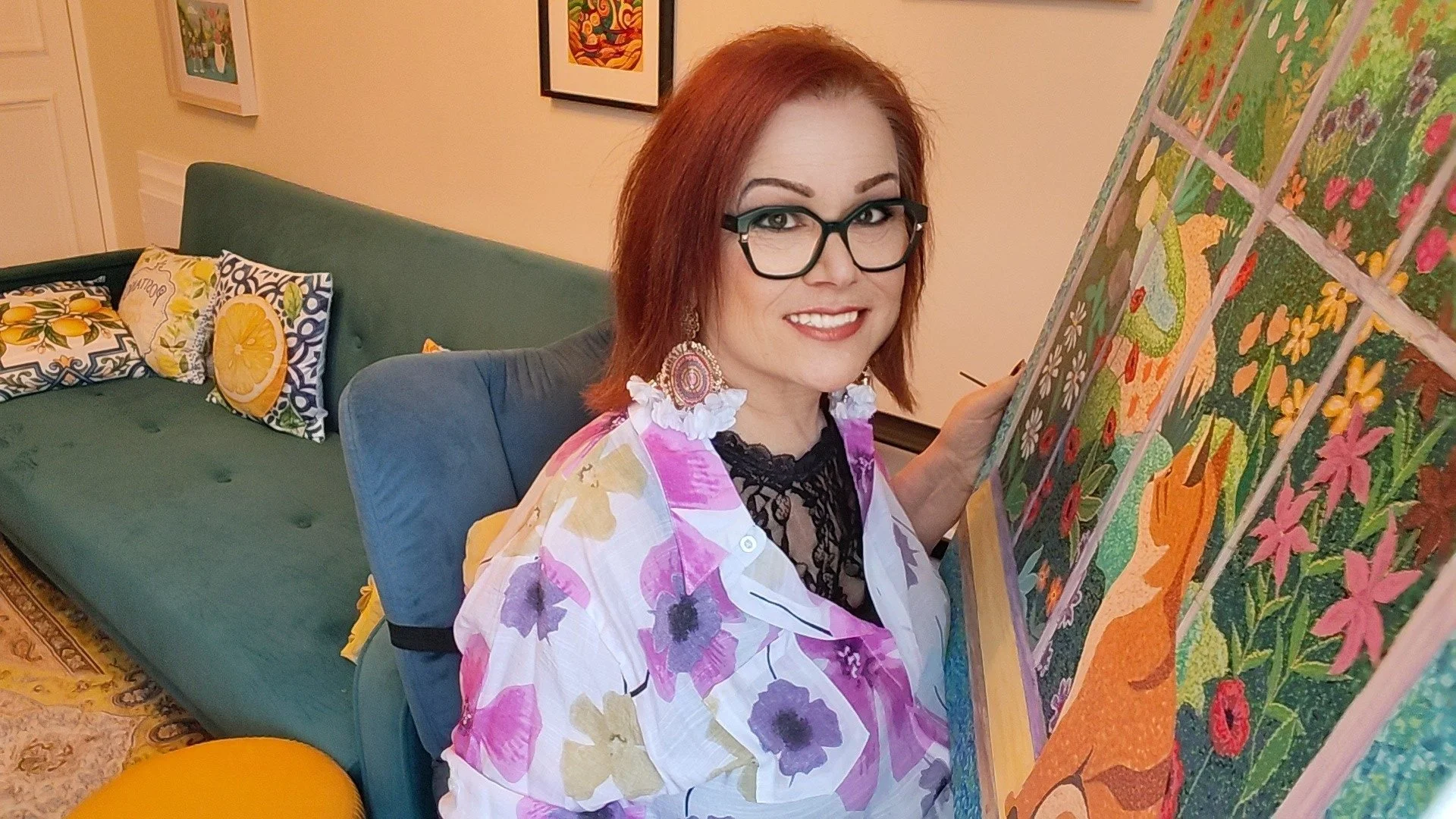
Franck Maunoury: A holobiont is a host and its community of organisms. Why did that idea belong in Holobiont 1, 2 and 3, and how do the acrylic and the digital collage work together?
The concept of the holobiont challenged my perception of the individual as a self-contained entity. A human body is also an ecosystem, inhabited by and dependent upon countless other organisms. This idea naturally became a visual subject for me.
Acrylic painting provides a physical, human and tactile presence, while digital collage allows the image to fragment, multiply and extend beyond its original boundaries. Their combination mirrors the coexistence and interdependence at the heart of the holobiont concept.
Divya Vinod Gilatar: Holy Blood is a striking title for a digital work. What does the phrase mean in this piece?
The title Holy Blood deliberately brings together two ideas that are often treated as opposites. Menstrual blood has historically been surrounded by ideas of impurity, secrecy and shame, yet within certain spiritual traditions it carries profound associations with fertility, creation and divine feminine power.
My work is particularly inspired by Maa Kamakhya, the Bleeding Goddess, whose temple is situated on Nilachal Hill in Assam. Her spiritual tradition is deeply connected with menstruation, fertility and Shakti, the divine feminine principle. By calling the work Holy Blood, I wanted to reclaim that contradiction and ask why blood connected with female creation should ever be considered lesser or unclean. The title transforms the body from something judged into something sacred.
Manuela Dantand: VEILED is a large acrylic on canvas, shown digitally in Lyon. What is being veiled in this painting, and why that scale?
VEILED is a 70 × 100 cm mixed-media painting on canvas. I chose the vertical format because it gives the partially concealed face a strong presence. From the beginning, I was fascinated by the aesthetics of a face that isn't fully visible. The black areas, soft transitions and different textures were all deliberate artistic choices.
But when the painting was finished, I noticed something unexpected. Suddenly, I had the feeling that the woman in the painting was watching me. It almost seemed as though eyes were emerging through the dark areas, even though I had never consciously painted any there. I still find that fascinating. Sometimes you discover something in your own artwork that you never intended to create.
Rosa Almeida: Cactus in Bloom is acrylic over pastel on paper. Why a cactus in flower, and what does layering acrylic on pastel give you?
I was fascinated by the contrast between the cactus and its flower: a plant that protects itself with sharp spines, yet is capable of producing something so delicate and beautiful. I see this as a metaphor for life, where strength and sensitivity can exist side by side.
Working with acrylic over pastel allows me to explore different textures, transparencies and layers. The pastel brings softness and spontaneity, while the acrylic adds depth, intensity and definition. I love the dialogue between these materials and the unexpected effects they create.
Alexis Lovely: What other areas have you taken your artistry into?
I've brought my art into fashion through two footwear collaborations and my Los Angeles Fashion Week debut. I enjoy seeing how an idea changes when it goes from something you see on a screen to something you can wear. Footwear gives me another way to work with colour and form, and I'm looking forward to designing more shoes.
Meet the Artists
Catherine Vella
Catherine Vella is a French painter of Italian origin whose career spans more than thirty years. After working in oils for many years, she now paints mainly in acrylic, with a generous palette and a constant exploration of light and emotion. Her Mediterranean landscapes, figures, animals and flowers seek to convey a positive feeling.
In the Lyon show:
- Le chat à la fenêtre, 2026. Acrylic on canvas, 70 × 90 cm.
- Souvenirs d'Italie, 2026. Acrylic on canvas, 70 × 90 cm.
- Instagram: @colorfulcathie
Credits: All images: Catherine Vella (@colorfulcathie). Catherine answered in French; her answers have been translated into English.
Franck Maunoury (Monor)
Monor, the artistic name of French painter Franck Maunoury, lives and works near Le Mans, France. His practice explores the human condition and our relationship with the living world, combining academic painting techniques with digital processes. His current research focuses on the concept of the holobiont and on the complex relationships connecting living beings to one another and to their environment.
In the Lyon show:
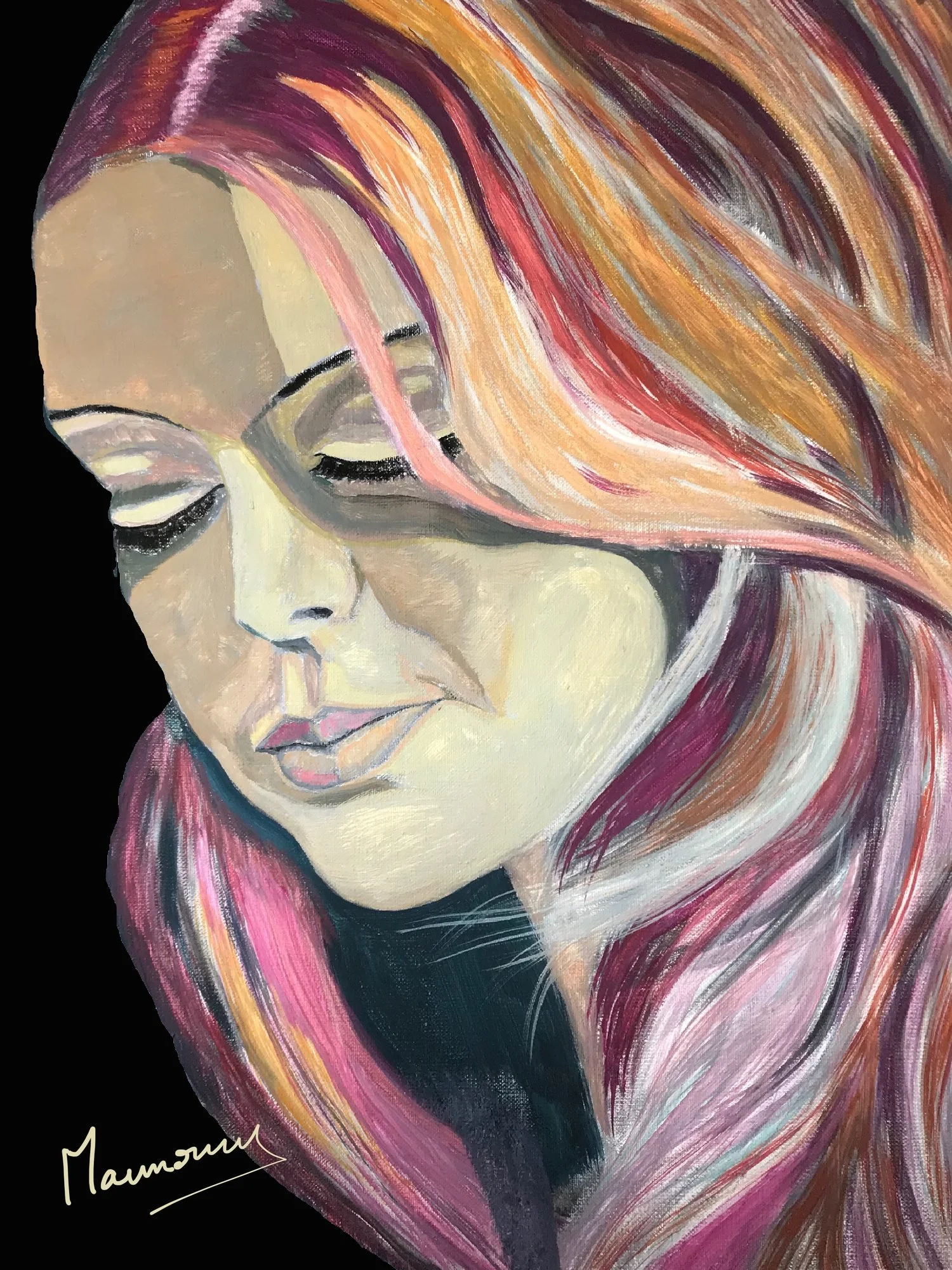
- Holobiont 1, 2025. Mixed media: acrylic on canvas and digital collage.
- Holobiont 2, 2025. Mixed media: acrylic on canvas and digital collage.
- Holobiont 3, 2025. Mixed media: acrylic on canvas and digital collage.
- Instagram: @monor_arts_franckmaunoury
- Website: monorarts.com
Credits: All images courtesy of Franck Maunoury (Monor) (@monor_arts_franckmaunoury).
Divya Vinod Gilatar
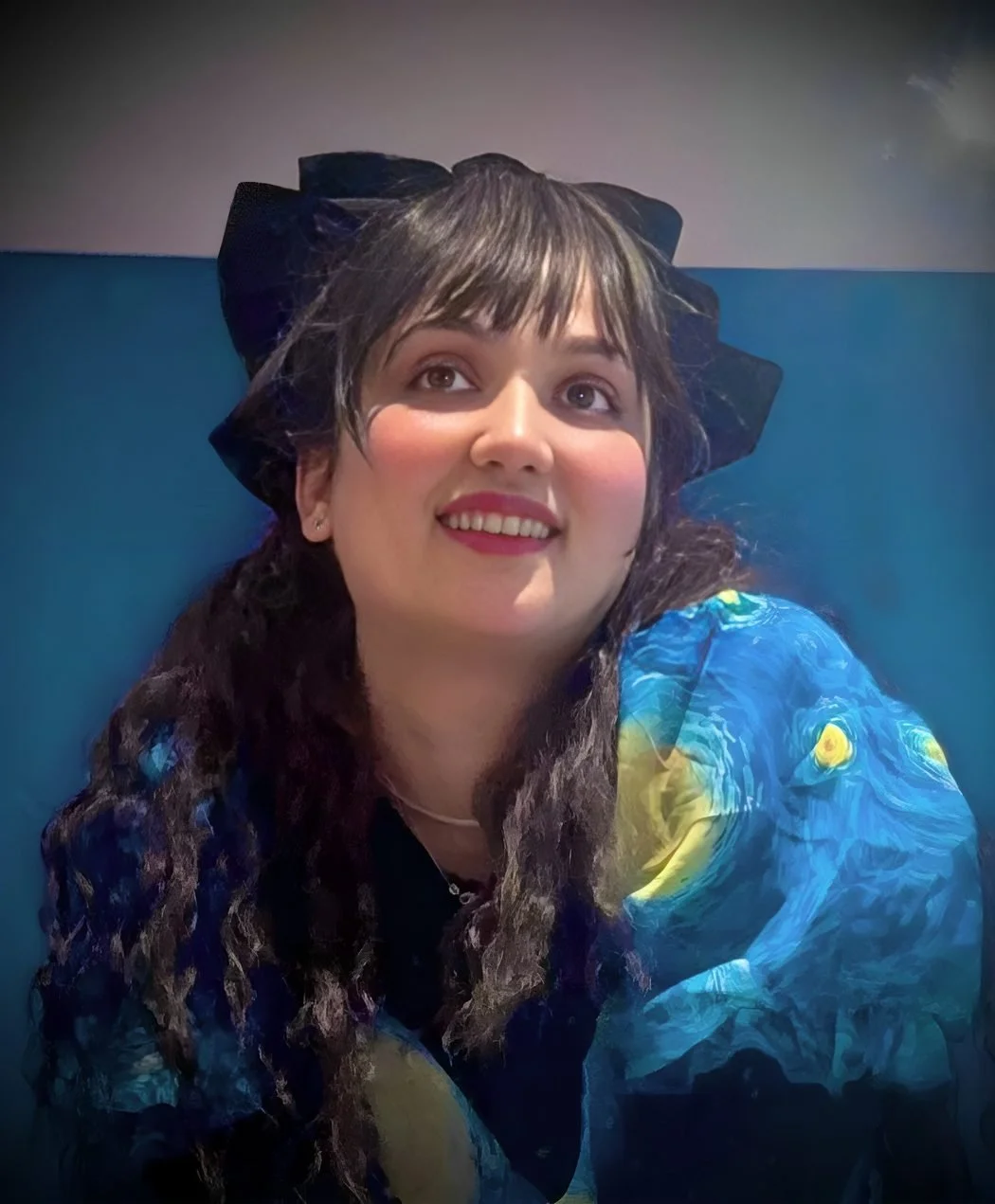
Divya Vinod Gilatar is an Indian contemporary artist, writer and educator whose practice explores spirituality, feminine identity, cultural memory and the relationship between the body and the sacred. Drawing upon Indian philosophy and divine feminine symbolism, her work combines intricate digital imagery with personal and spiritual narratives to examine womanhood, transformation and embodied experience.
In the Lyon show:
- Holy Blood, 2026. Digital artwork, 8.5 × 11 in (21.6 × 27.9 cm).
- Instagram: @thequeendomstudio
Credits: All images courtesy of Divya Vinod Gilatar (@thequeendomstudio).
Manuela Dantand
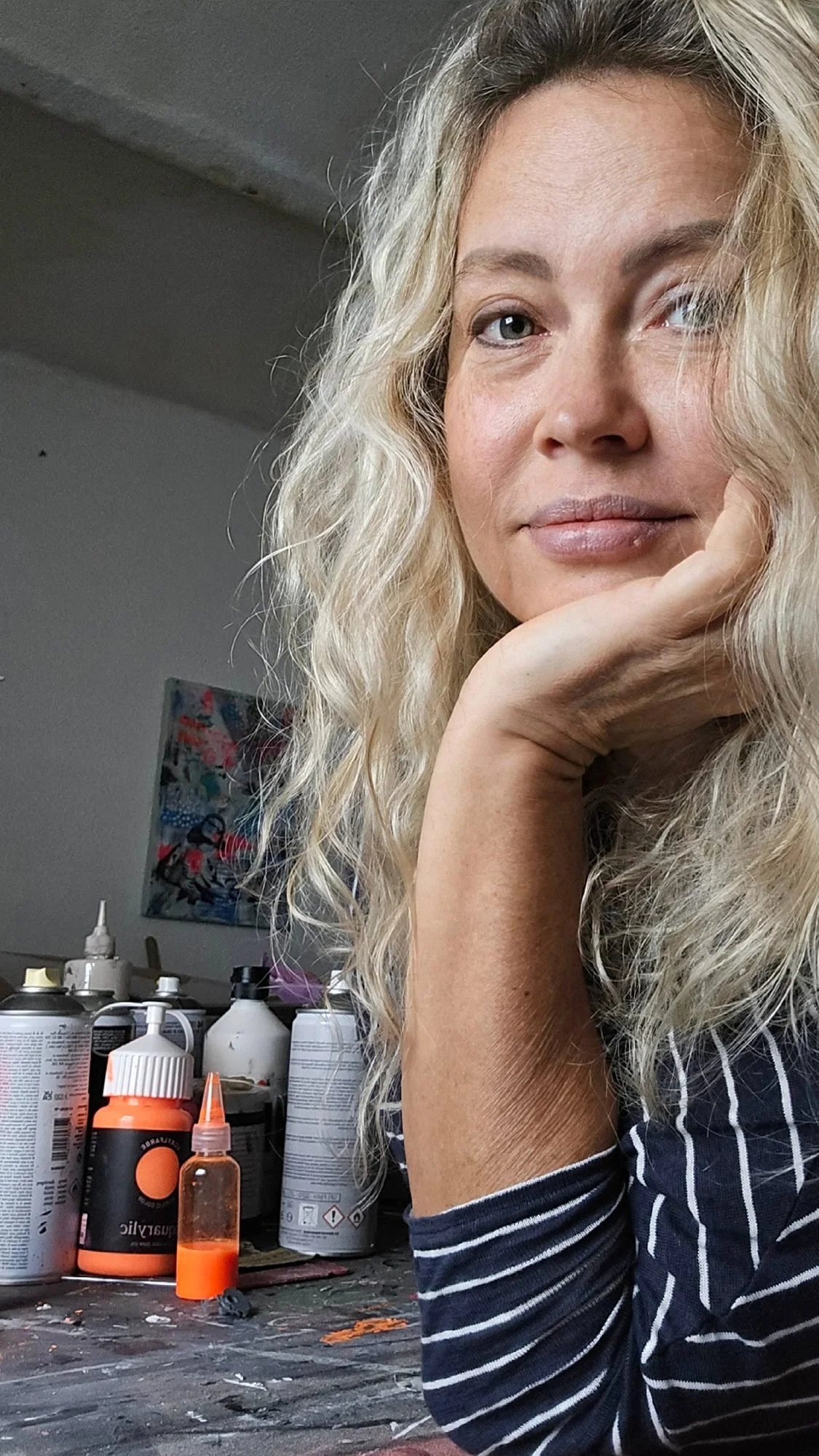
Manuela Dantand is a contemporary artist based in Vienna, Austria, who has been developing her distinctive visual language between Pop Art and abstraction since 2020. Her work is characterised by expressive textures, bold contrasts and deliberate stylistic contrasts. She creates original artworks with a strong presence that transform spaces and encourage viewers to take a closer look.
In the Lyon show:
- VEILED, 2026. Mixed media: acrylic and charcoal on canvas, 70 × 100 cm, shown digitally.
Also by the artist:
- SHE KNOWS, 2026. Mixed media: acrylic, charcoal and modelling paste on canvas, 80 × 100 cm.
- Instagram: @art.no.deco
- Website: artnodeco.at
Credits: All images courtesy of Manuela Dantand (@art.no.deco).
Rosa Almeida
Rosa Almeida is a Portuguese visual artist whose work explores colour, movement, organic forms and the expressive possibilities of painting. Working mainly with acrylic, pastels and mixed media on canvas and paper, she embraces an intuitive and experimental approach, drawing inspiration from nature, travel and everyday experiences. Her work has been selected for international exhibitions and publications, including HUGE Gallery's exhibition in Lyon and 100 European Women in Art 2026 by Culturale Lab.
In the Lyon show:
- Cactus in Bloom, 2026. Acrylic over pastel on paper, 40 × 60 cm.
- Instagram: @art_rosa.almeida24
Credits: All images courtesy of Rosa Almeida (@art_rosa.almeida24).
Alexis Lovely
Alexis Lovely is a Los Angeles–based artist and Creative Director whose practice spans digital painting, immersive installations and fashion. Her work has been shown in Times Square and during Art Basel Miami, and she co-created Crystalline Complex, the virtual counterpart to Coachella's iconic Spectra Tower. She has collaborated with adidas NEO and Reebok and made her runway debut at Los Angeles Fashion Week.
In the Lyon show:
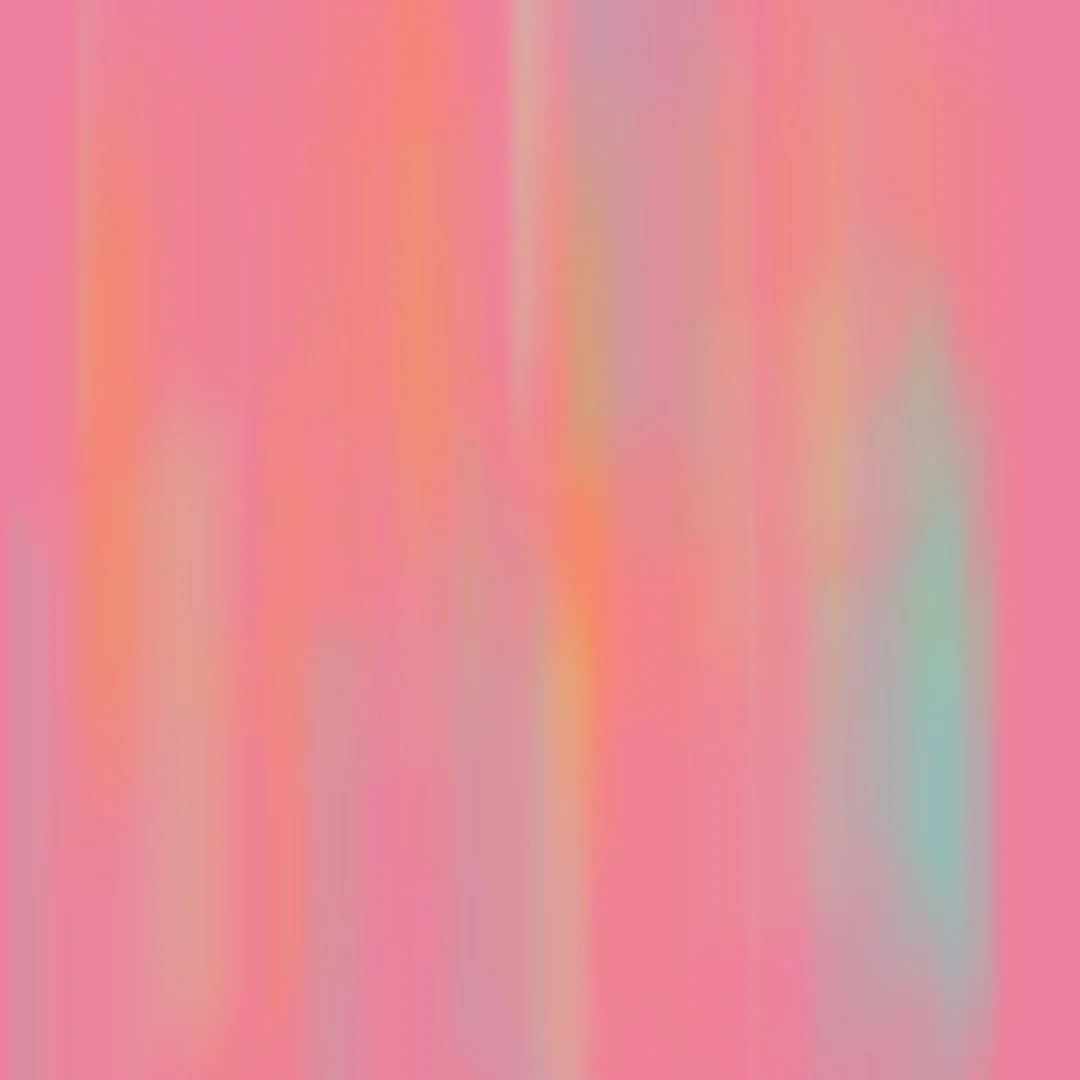
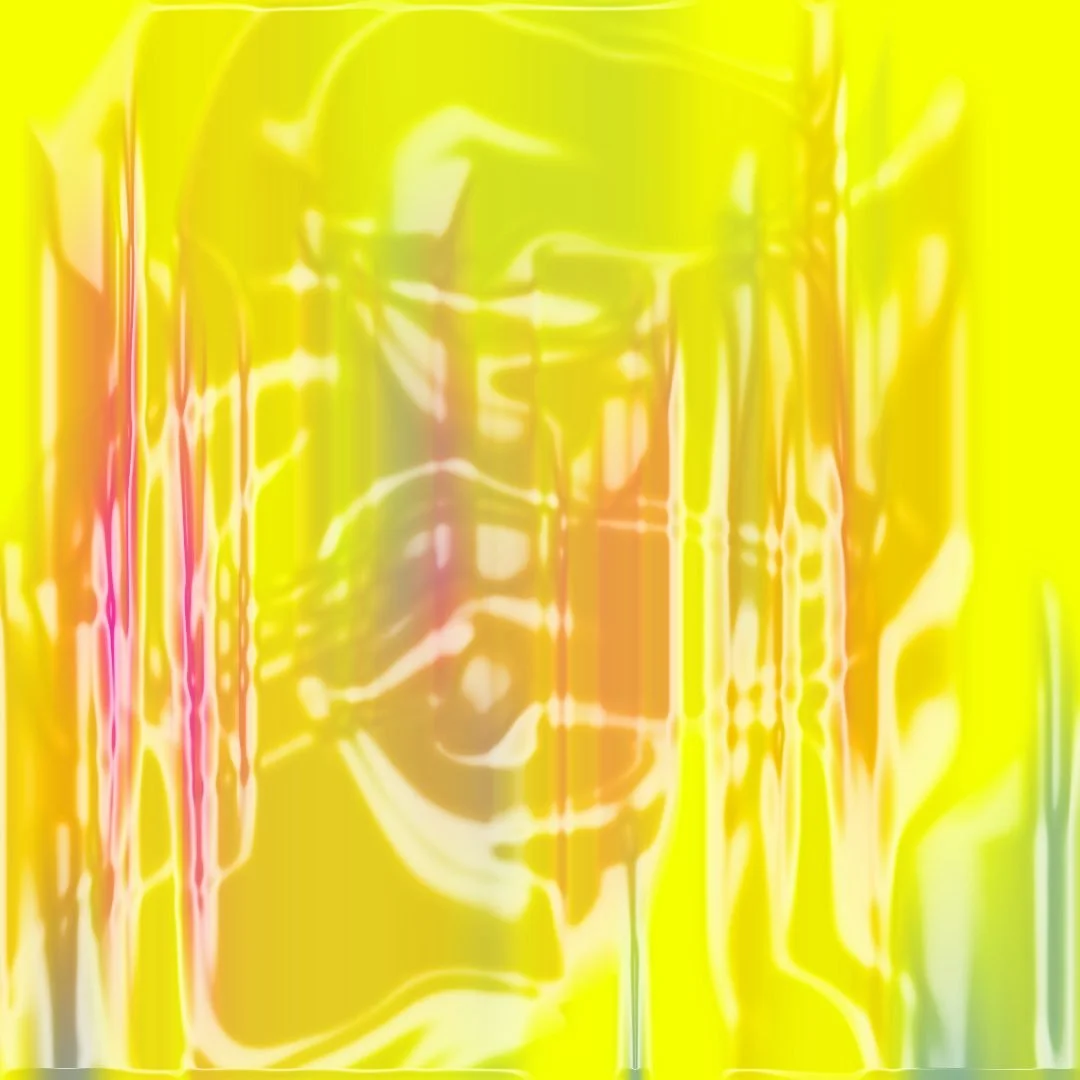
- Lumières, 2026. Digital painting, 1080 × 1080 pixels.
Also by the artist:
- Phoenix rising, 2026. Digital painting, 1080 × 1080 pixels.
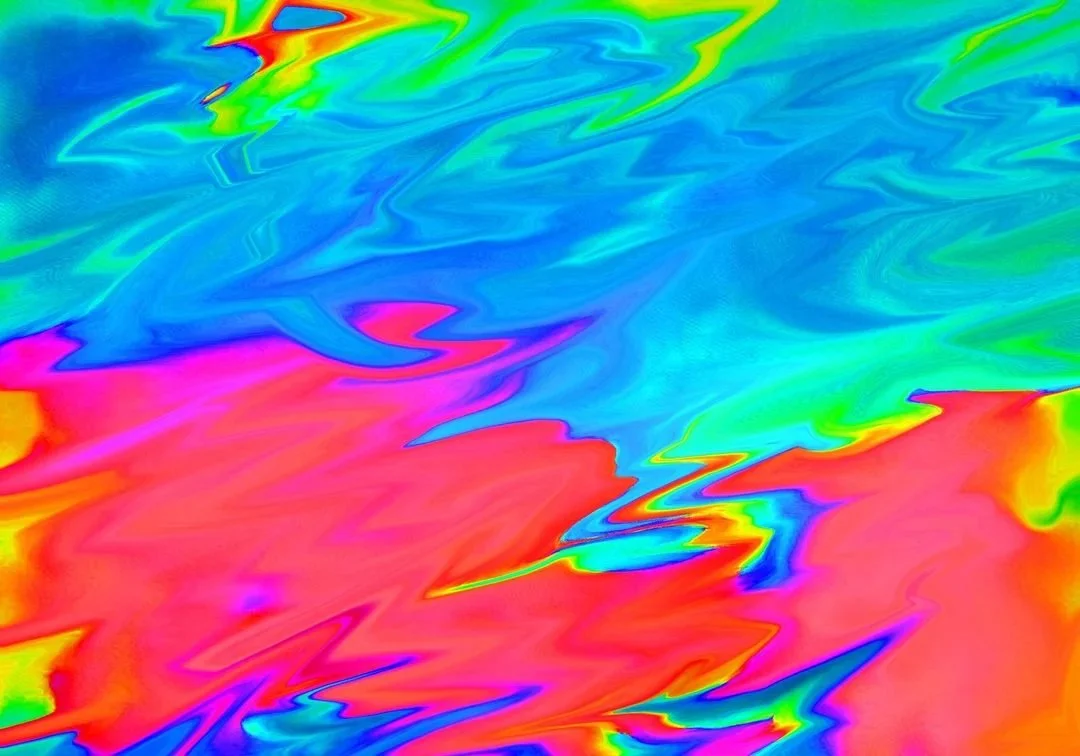
- Heatwave, 2022. Digital painting, 1080 × 756 pixels.
- Instagram: @alexislovely
- Portfolio: alexislovely.myportfolio.com
Credits: All images courtesy of Alexis Lovely (@alexislovely).
See the Work in Lyon
HUGE Gallery Lyon
53 Cours Tolstoï, 69100 Villeurbanne, France
4–6 December 2026
Opening evening: Friday 4 December 2026, 18:00–21:00.
Get your tickets on Eventbrite
Are you an artist who would like to show with us? See our current open calls.
